Beyond the Agenda: The Hidden Dynamics That Really Decide
November 4, 2025
8 min read
The most important decisions in an organization are rarely settled by what sits on the agenda. They are settled by what happens around it.
Key takeaways
Every boardroom runs two systems at once: the formal one of agendas, papers, and minutes, and the informal one of relationships, framing, and influence. Effective leaders manage both.
Many decisions are effectively made before the meeting, through how the problem is framed, who has aligned with whom, and which concern goes unspoken.
The goal is not to abolish informal influence, which is impossible, but to make it visible, productive, and accountable.
In relationship-driven cultures like the GCC, the informal system is especially powerful, which makes designing for it a leadership discipline rather than an afterthought.
Leadership teams like to believe decisions are made inside the meeting. The agenda is circulated, the papers are read, the discussion happens, an outcome is recorded, and governance looks complete. Most experienced executives know it rarely works that way. Sometimes the real decision was taken before anyone sat down. Sometimes it turned on a single question that reframed the problem. Sometimes it was shaped by a quiet exchange between two people who matter. And sometimes it was decided by a concern that was never voiced at all. This is not dysfunction. It is how human organizations operate. The problem is that most governance systems are built to manage the visible conversation while ignoring the invisible one.
The cost of that blind spot is well documented. In McKinsey's global survey on decision-making, only 20% of executives said their organizations excel at it, and 61% said at least half the time they spend making decisions is wasted. Among the causes they named were an overreliance on consensus, "death by committee," and unclear authority. These are not failures of the agenda. They are failures to manage what happens around it.
Share
The real problem leaders underestimate: decision shadowing
Organizations assume decisions are shaped inside formal forums. In reality they are often shaped by a parallel system of relationships, framing, and informal alignment that runs alongside the official one. The gap between where a decision appears to be made and where it is actually shaped is worth naming: decision shadowing.
It takes four recognizable forms. The first is framing dominance, where whoever defines the problem has quietly shaped the answer before discussion begins. The second is silent influence, where a real concern stays unspoken because of hierarchy, culture, or a reluctance to create friction, and the silence is then misread as consent. The third is stakeholder gravity, where certain individuals move decisions despite holding no formal authority over them. The fourth is corridor governance, where positions are settled in pre-meetings and side conversations, so the formal forum merely ratifies a decision already taken elsewhere. When these forces stay invisible, leaders confuse participation with alignment and discussion with deciding.
This is amplified in the GCC, where business is relationship-driven, seniority carries weight, and disagreement is often expressed indirectly to preserve harmony and standing. None of that is a flaw. But left unmanaged, it means the formal record captures only part of how the decision was actually made, and the unrecorded part is the part that resurfaces later as hidden resistance.
A better lens: govern both systems, not one
High-performing leadership teams accept a simple truth. The formal system of committees, minutes, and approvals and the informal system of trust, narrative, and influence both operate at all times. Most governance failures come from managing one while ignoring the other. The objective is not to eliminate informal dynamics, which cannot be done and should not be attempted, but to surface them and fold them into better decision design so that influence becomes traceable rather than mysterious.
The SHADOW framework
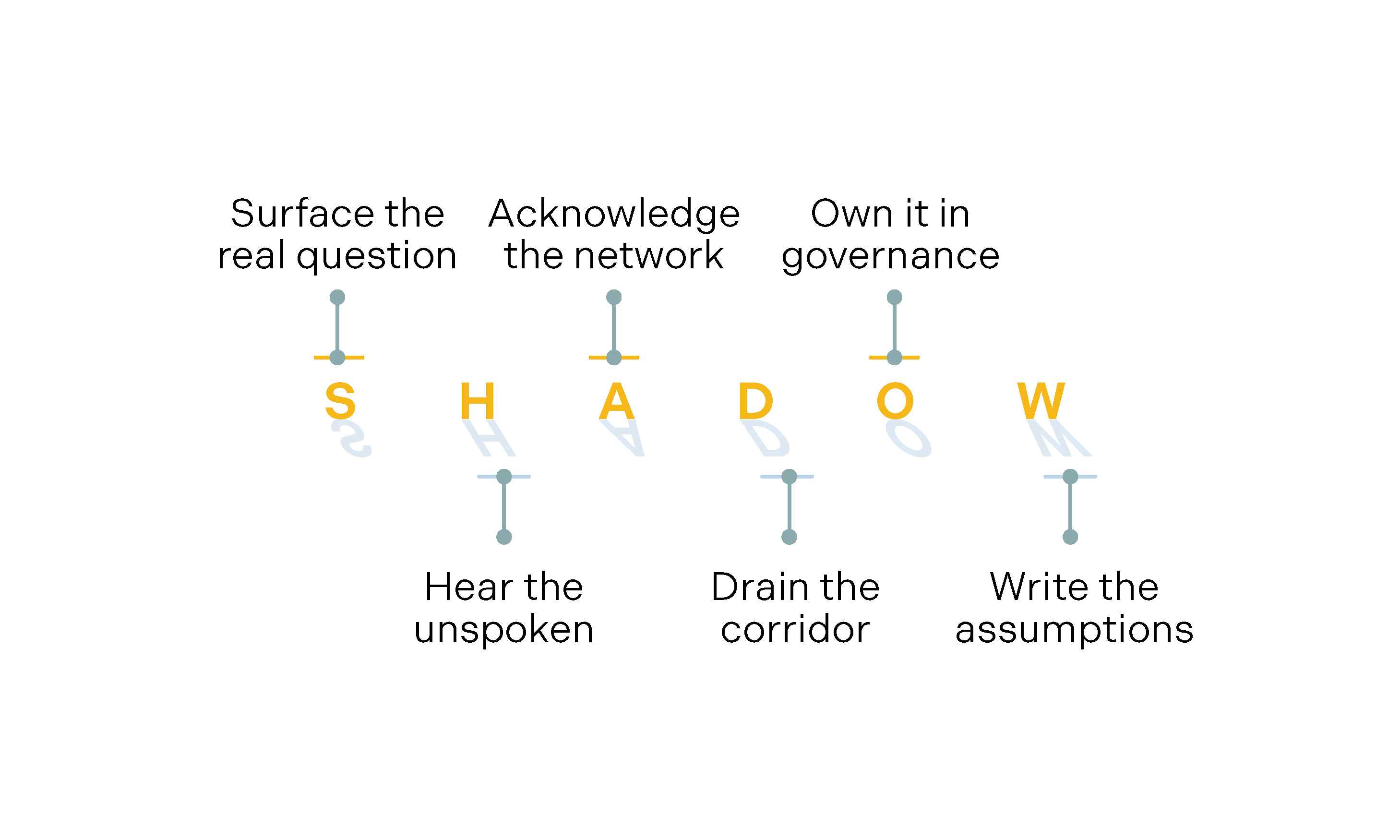
To bring hidden dynamics into the light, leaders can apply SHADOW.
S, Surface the real question
Before debating solutions, agree the actual decision and the trade-off underneath it, and notice who framed it, because the framing is often the first hidden decision in the room.
H, Hear the unspoken
Treat silence as a signal to investigate, not a sign of agreement. Create deliberate openings for the concern no one wants to be first to raise, so dissent informs the decision rather than sabotaging it afterward.
A, Acknowledge the network
Map who genuinely shapes a given decision, looking past titles to expertise, trust, and institutional credibility. You cannot manage stakeholder gravity you have not located.
D, Drain the corridor
Bring pre-meeting alignment into the open. Use structured pre-reads and early consultations to make positions visible before the forum, converting corridor governance from a hidden decision into transparent preparation.
O, Own it in governance
Informal alignment should inform the decision, never replace it. The formal forum is where the choice becomes real, with a documented rationale, a named owner, a timeline, and a revisit trigger. Governance is what confers legitimacy.
W, Write the assumptions
Record what the decision rests on, not just what was decided. Visible assumptions are what make later learning, and honest revisiting, possible.
What good looks like
When decision shadowing is managed well, the shifts are visible. Presentation meetings give way to decision forums. Silent agreement gives way to constructive challenge. Corridor governance gives way to transparent alignment. Personality-driven influence gives way to process-supported decisions. And recurring debates give way to documented closure. The room becomes more effective precisely because the invisible dynamics have become manageable.
How to execute: five moves in the next 30 days
Audit recent leadership meetings and flag the decisions that were discussed repeatedly without ever closing, since those are where shadowing is strongest. Map the influence network for your most consequential decisions, distinguishing formal decision-makers from informal shapers. Move pre-alignment into the open by requiring substantive pre-reads and early consultation before major forums. Install decision journals that record rationale, assumptions, and revisit triggers, building a memory the organization can learn from. And review who actually speaks across leadership meetings, so a narrow set of voices is not quietly setting every outcome.
Risks and trade-offs
The first risk is over-formalization, where attempts to stamp out informal influence simply slow everything down; the answer is to acknowledge informal dynamics while keeping formal discipline. The second is artificial consensus, where harmony is preserved by avoiding disagreement; the answer is to build challenge into the process rather than hope for candor. The third is influence concentration, where a few voices dominate; rotating facilitation and broadening participation help. The fourth is governance theatre, where forums become performances because the real decision was taken elsewhere; the only remedy is to insist that the formal forum remains the place where decisions actually close.
Leadership questions
Where are our most important decisions actually being shaped?
Which concerns stay consistently unspoken in our leadership discussions?
Are we reading silence as agreement?
Who influences our outcomes without holding formal authority?
Does our governance reveal how decisions are really made, or merely document the version we are comfortable recording?
The effectiveness of a boardroom is not set by the quality of its agenda. It is set by how well it surfaces what would otherwise stay hidden. The strongest governance systems do not pretend the informal layer does not exist. They make it visible, discussable, and accountable, and in doing so they turn the dynamics beneath the conversation from a source of risk into a source of better decisions
Share
References
McKinsey & Company. Decision making in the age of urgency (Global Survey of more than 1,200 managers). Only 20% of respondents say their organizations excel at decision making; 61% report that at least half their decision-making time is used ineffectively; causes cited include overreliance on consensus, "death by committee," and unclear decision rights.
McKinsey & Company. Three keys to faster, better decisions. Faster decisions correlate with higher quality; the discipline is to involve the right people substantively without granting everyone a vote or veto.


.jpg)
.svg)