Funding Confidence: How to De-Risk Your First AI Investment in Just a Few Weeks
September 11, 2025
8 min read
The AI conversation has shifted from “what is possible” to “what is controllable.” Here is how GCC leaders can bypass pilot purgatory and secure board approval with evidence-based baselines.
Key takeaways
Start with proof, not promises. De-risk AI by baselining a single workflow and showing measurable “before/after” impact—cycle time, rework, and error rates—within a 30-day window.
Follow the friction, not the hype. Returns are highest where operational drag is expensive and repetitive, not necessarily where the technology is most dazzling.
Governance is the funding unlock. The biggest barrier to investment is undefined risk. Clear Human-in-the-Loop (HITL) rules are often the difference between “interesting” and “approved.”
Make guardrails operational. Replace abstract principles with a plain-language Use Policy, decision notes, and escalation triggers—so teams can move fast and stay trusted.
Why This Matters Now
In 2026, the GCC boardroom has matured past the novelty phase. Directors no longer ask, “Is AI real?” They ask the questions that actually determine funding: “Is this controllable? Will it pay off? Who owns the risk when it doesn’t?”
That shift is healthy—and unforgiving. Many organizations are committed to scaling AI, yet only a small share can credibly connect AI to earnings impact. Everyone else is stuck in what executives quietly call pilot purgatory: a shelf of successful demos and “promising” proofs of concept that never survive audit, compliance, operational handover, or CFO scrutiny.
The pressure to modernize is real, amplified by national agendas and rising expectations for productivity. But “we should do AI” is not a funding case. The fastest path from skepticism to sign-off is evidence: a narrow, measurable first move that makes risk legible.
Share
The Real Problem: “AI” Is Too Abstract to Fund
Boards don’t fund abstractions. They fund outcomes with bounded risk. Many first AI pitches fail because they present an exciting portfolio—chatbots, agents, predictive models—without answering three basic questions:
Where will value land? (Which workflow, specifically?)
How will we measure it? (What baseline proves improvement?)
Who is accountable? (Which business owner signs the decision?)
When those answers are missing, the reaction is predictable: the CFO pushes back on vague ROI ranges, Risk and Compliance raise legitimate concerns, and the initiative stalls under the weight of “let’s get more clarity.”
The mistake is treating AI as a technology project—something IT can “implement.” In reality, AI is workflow redesign plus governance. Without a measurable baseline of today’s workflow, “tomorrow’s improvement” is just a story.
Point of View: Confidence Through Constraints
Evidence beats enthusiasm. Boards don’t fear experimentation; they fear uncontrolled experimentation. Funding confidence comes from constraints that turn uncertainty into a managed learning loop:
Narrow scope (one workflow, not “the enterprise”)
Clear success criteria (metrics agreed upfront)
Explicit accountability (named business owner, not “the AI team”)
Fast feedback (scale-or-kill decisions in weeks, not quarters)
You don’t start with an enterprise AI strategy. You start with a decision-ready first move—one workflow, one outcome metric, and guardrails the organization can actually follow on Monday morning.
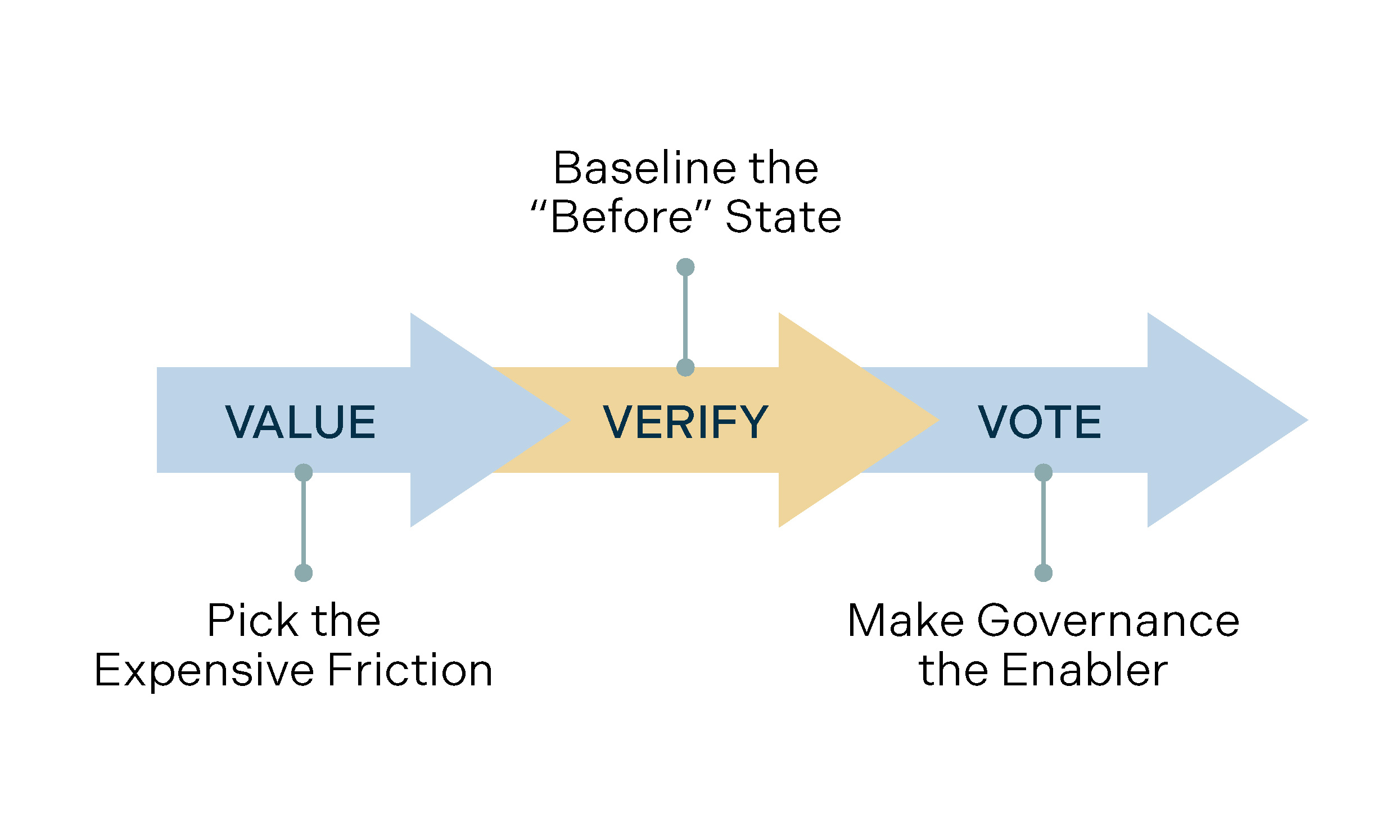
The Framework: VALUE → VERIFY → VOTE
Use this three-step discipline to move from hesitation to approval quickly—without sacrificing control.
VALUE: Pick the Expensive Friction
Start where AI removes real operational pain: triage, drafting, forecasting, first-response ticketing, quality checks, compliance review. Avoid “prestige pilots” designed to impress rather than compound.
A strong first workflow is typically: high-volume, moderately complex, measurable, and owned by a leader who feels the pain daily (e.g., Head of Customer Operations, Claims, Procurement, Finance FP&A).
Output: a ranked shortlist of candidate workflows by impact × feasibility × risk.
VERIFY: Baseline the “Before” State
Before building anything, measure the workflow today. Not anecdotes—numbers:
cycle time (end-to-end)
error rates and exception rates
rework hours and handoffs
escalation frequency
cost per transaction / cost-to-serve (where relevant)
This is where credibility is won. You’re converting “AI could help” into “Here is the precise deficit we will reduce.”
Output: a pilot charter with success thresholds (e.g., “reduce first-draft time by 40%,” “cut rework by 25%,” “reduce escalations by 15%”).
VOTE: Make Governance the Enabler
AI cannot quietly inherit authority. Define Human-in-the-Loop (HITL) rules from day one:
which outputs must be reviewed by a human
when humans override the model
what gets logged (assumptions + rationale)
what triggers escalation (confidence thresholds, drift flags, bias indicators)
Then formalize a Scale-or-Kill Gate: if the pilot hits KPIs, expansion funding is automatic; if not, it is retired without drama.
Output: a board-ready governance posture—controls that enable speed rather than smother it.
What Good Looks Like
Organizations that win funding confidence show consistent patterns:
From “AI ambition” → “workflow proof.” One measurable outcome beats ten clever use cases.
From “IT project” → “business-owned change.” The workflow owner owns the outcome. IT supports; Risk assures; the business decides.
From “risk avoided” → “risk governed.” Guardrails are embedded in the process (e.g., mandatory human sign-off above thresholds), not added as new committees.
How to Execute: A 3-Week Sprint
A tight sprint structure keeps scope honest and momentum high:
Week 2: Pilot design + controls. Define AI insertion points, stop rules, HITL gates, draft the plain-language Use Policy.
Week 3: Board pack. Present baseline, ROI range, risk posture, owner model, and the scale-or-kill gate.
Risks and Trade-offs
Pilot theater: activity without impact. Mitigation: define success thresholds before day one.
Scope creep: “enterprise transformation” on day five. Mitigation: one workflow, one metric, one time-box.
Data integrity drag: model works but data definitions are disputed. Mitigation: make “decision-grade data” a go/no-go criterion, not a future aspiration.
Leadership Questions
Which workflow is costing us the most time through repeatable friction right now?
Do we have a baseline—or only opinions?
Who owns the output when AI is involved: IT, vendor, or business leader?
What specific guardrail would make Risk say “yes” next week?
What is our scale-or-kill gate—and who will enforce it?


.jpg)
.svg)