The Founder's Dilemma: How to Keep Entrepreneurial Energy Alive at Scale
December 11, 2025
8 min read
The greatest threat to an entrepreneurial organization is not failure. It is success, and the complexity that success quietly installs.
Key takeaways
Growth tends to create the very conditions that suppress the behaviors that drove early success. The problem is structural, not generational.
Entrepreneurial energy is an operating capability, not a personality trait. Organizations move fast when the system lets them, and slow down when it does not.
Preserve speed, experimentation, and customer proximity on purpose, because none of them survives scale by default.
The aim is not to keep the founder. It is to keep the founder's mentality after the founder, and the start-up, are gone.
Every successful organization starts with a founder's mindset. Decisions are fast, teams sit close to customers, problems get solved directly, and resources are scarce while energy is abundant. The organization moves because the people move. Then success arrives. The company grows, functions multiply, governance matures, processes accumulate, committees form, approvals lengthen, and risk management improves. Gradually something shifts. The organization becomes more sophisticated and less entrepreneurial. This is one of the most common paradoxes in business: the systems that help a company scale often weaken the behaviors that made it worth scaling.
The evidence is unusually clear on where the danger comes from. Bain's multi-year study of roughly 8,000 companies found that 85% of the barriers to profitable growth are internal and manageable rather than external, a figure that rises to 94% for the largest firms. The same research found that only about one company in nine sustains profitable growth over a decade, and that firms which deliberately preserve a founder's mentality have around five times the chance of avoiding the internal crises that stall growth. The enemy, in other words, is rarely the market. It is the complexity a company builds into itself as it succeeds.
Share
The real problem leaders underestimate: founder fade
Most organizations assume entrepreneurship declines because founders leave or because culture changes with size. Something more mechanical is usually at work. As a company scales, decision-making spreads across more hands, governance becomes more structured, and experimentation becomes more constrained, until the behaviors that once came naturally now require permission. This is founder fade: the gradual erosion of entrepreneurial behavior as organizational complexity increases.
It tends to appear in four forms. Decision drag sets in when simple choices start requiring multiple approvals and stakeholders. Customer distance grows as leaders spend more time in internal meetings and less time in front of the people they serve. Risk inflation takes hold when avoiding mistakes quietly becomes more important than pursuing opportunities. And initiative dependency emerges when innovation becomes the job of a designated department rather than a shared behavior. The organization keeps growing, but its ability to adapt, experiment, and move declines. This matters acutely in the GCC, where many of the region's most successful family groups and national champions are scaling fast and professionalizing at the same time, and where the founding generation's speed is precisely the asset most at risk of being engineered out.
A better lens: entrepreneurship is designed, not inspired
Many organizations treat entrepreneurship as a cultural attribute to be rekindled with a campaign. High-performing ones treat it as a property of how work is structured. People move quickly when decisions move quickly. People experiment when experimentation is safe and cheap. People take ownership when ownership is real. So the useful question is not "how do we make our people more entrepreneurial?" but "how do we make entrepreneurial behavior the path of least resistance?" That shift moves the conversation from motivation to design, which is the only place it can actually be solved.
The EDGE framework
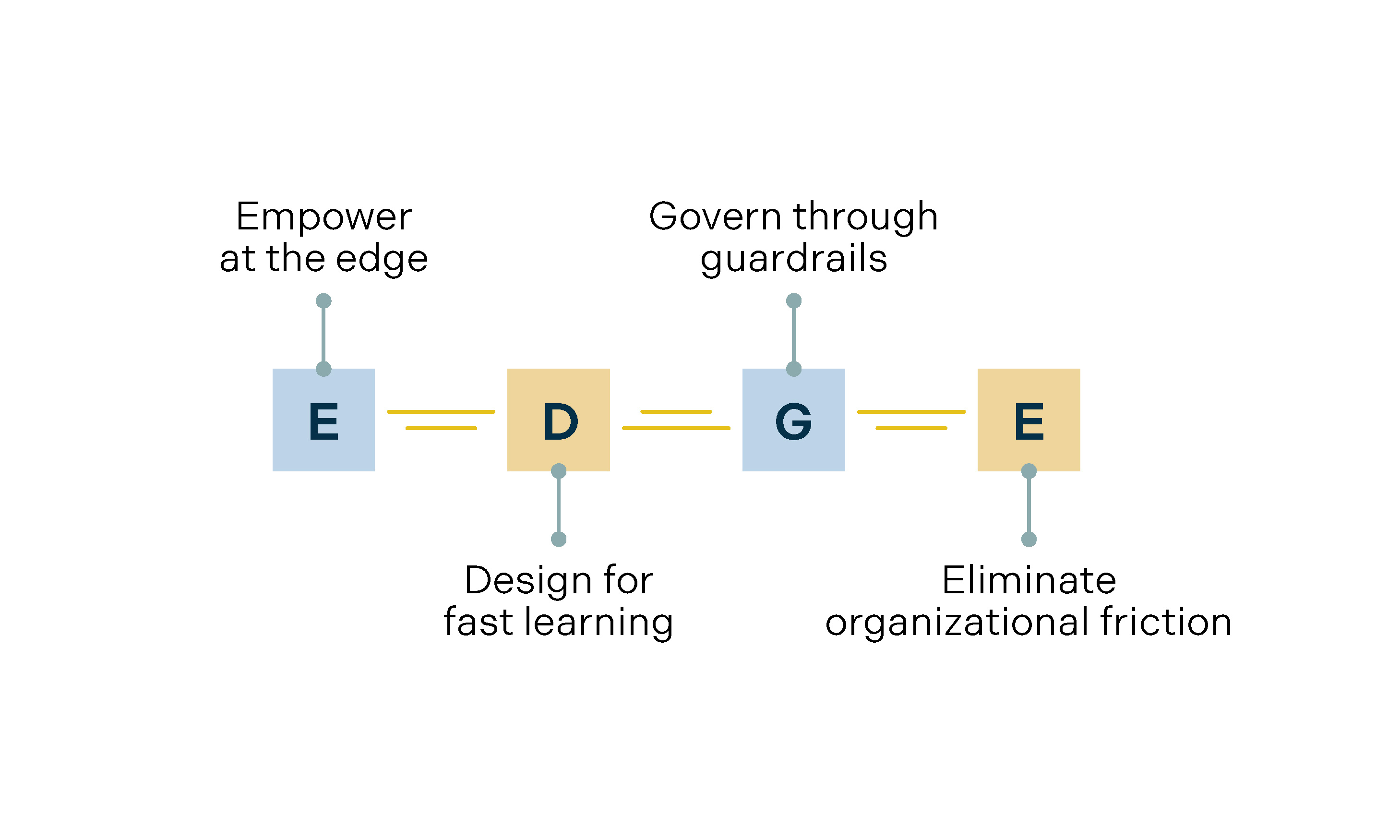
To preserve entrepreneurial energy while keeping enterprise discipline, leaders can apply EDGE.
E, Empower at the edge
Push decisions toward customers, operations, and market realities, and build small teams with authority over outcomes rather than activities. Entrepreneurship grows where ownership is genuine, and withers where every consequential call travels upward.
D, Design for fast learning
Replace the long business case with short experimentation cycles built on small investments, rapid testing, and quick iteration. Organizations learn faster when the cost of trying something is low, and they stop learning when every idea must survive a committee before it can be tested.
G, Govern through guardrails
Entrepreneurship does not require the absence of governance; it requires the right kind. Set spending thresholds, risk boundaries, and escalation triggers so that boundaries are explicit. Clear guardrails speed movement up, because people no longer have to ask permission for things that were already inside the lines.
E, Eliminate organizational friction
Make the removal of unnecessary approvals, duplicate reporting, redundant committees, and low-value activity a continuous discipline rather than a one-off purge. Entrepreneurial energy returns as friction falls, and fades again the moment complexity is allowed to creep back.
What good looks like
Organizations that hold on to founder energy show recognizable shifts. Approval-seeking gives way to empowered ownership. Risk avoidance gives way to intelligent experimentation. Annual innovation programs give way to continuous learning. Functional silos give way to customer-focused teams. And bureaucracy gives way to disciplined agility. The organization comes to feel larger in capability but smaller in behavior, retaining the speed of its early years inside the scale of its maturity.
How to execute: five moves in the next 60 days
Stand up an edge team, a small cross-functional group given real authority to solve one specific customer or operational problem end to end. Create an options fund, a modest pool of capital for rapid testing and learning that does not require the full business-case process to access. Review decision bottlenecks and identify the approvals that delay execution without meaningfully reducing risk, then remove them. Introduce learning reviews that judge experiments on the insight gained rather than on immediate success, so that intelligent failure stays safe. And measure entrepreneurial flow by tracking decision speed, experimentation rates, cycle time, customer proximity, and retired work, so the behaviors you care about are visible.
Risks and trade-offs
The first risk is reckless autonomy, where too much freedom breeds inconsistency; clear guardrails and escalation thresholds contain it. The second is innovation theatre, where the organization celebrates ideas it never implements; the discipline is to reward measurable outcomes rather than activity. The third is resource fragmentation, where too many initiatives dilute attention; limit the number of live experiments and prioritize a few strategic themes. The fourth is governance rebound, the slow return of complexity after early success; audit friction regularly and keep removing what no longer earns its place.
Leadership questions
Which entrepreneurial behaviors have quietly diminished as we have grown?
Where does our decision-making move slower than our customers expect?
Which approvals exist mainly out of habit rather than genuine risk?
Are we funding experimentation, or merely discussing innovation?
If our founders walked back in tomorrow, which of our behaviors would surprise them most?
The organizations that thrive at scale are not the ones that cling to start-up culture. They are the ones that preserve start-up capability, the speed, ownership, and customer obsession that built them, and wire it into how the larger organization runs. Entrepreneurial energy is not something a leader summons once a year at a town hall. It is something an organization designs into the way it works every day. The real challenge of growth was never keeping the founder. It is keeping the mentality that made the growth possible in the first place.
Share
References
Bain & Company (Chris Zook and James Allen), The Founder's Mentality and Barriers and Pathways to Sustainable Growth. Five-year study of roughly 8,000 companies: 85% of barriers to profitable growth are internal and manageable rather than external, rising to 94% for the largest firms; only about one company in nine sustains profitable growth over ten or more years; firms that maintain a founder's mentality have roughly five times the chance of avoiding internal growth crises.
Bain & Company. Around 7% of companies achieve "scale insurgency," combining the benefits of size with founder-like behaviors, yet these firms account for more than half of the net value created in the stock market each year.


.jpg)
.svg)