The Hidden Power of Organizational Unlearning: Clearing the Path for Strategic Execution
May 15, 2025
8 min read
Key takeaways
Treat unlearning as an operating model decision. Retire outdated routines through explicit governance—don’t outsource it to culture messaging.
Target “legacy logic,” not just bad habits. Most drag comes from controls that were once rational but no longer protect value.
Make stopping safe and specific. Use the CLEAR cycle to define what gets retired, who owns the exit, and what replaces it.
Measure subtraction, not just addition. Track cycle-time reduction and controls retired—not training hours or “adoption” theater.
Most organizations are good at learning. They invest in new systems, new skills, new leaders, and new playbooks. But many transformations still stall for a simpler reason: they try to add modern ways of working on top of an old operating chassis.
In the GCC, this is amplified by both scale and velocity. Multi-entity groups are expanding across borders. National agendas are accelerating digitization. Risk sensitivity is high—reputation, compliance, and stakeholder confidence matter. Under pressure, organizations respond predictably: they add more dashboards, more committees, more escalations, more “alignment.” The intent is control. The outcome is congestion.
The real unlock in 2026 isn’t learning faster. It’s unlearning deliberately—retiring routines that were designed for yesterday’s risk profile and yesterday’s speed
Share
The real problem leaders underestimate: legacy logic
Unlearning is often framed as culture—mindsets, habits, attitudes. That’s only half the story.
The deeper source of drag is legacy logic: rules and routines that were once rational safeguards but now slow execution more than they reduce risk. They show up as:
Zombie controls: approvals that remain long after the original risk has changed (or disappeared).
Institutionalized workarounds: “temporary” spreadsheets and manual reconciliations that quietly became policy.
Control theater: steering committees and status rituals that signal seriousness but delay decisions.
Identity attachment: “We’ve always done it this way” disguised as “governance.”
This is how organizations accumulate what looks like operational maturity but behaves like operational cholesterol.
Common Pitfall Digitizing the process without retiring the logic. A workflow tool layered on top of the same approvals doesn’t create speed—it automates delay.
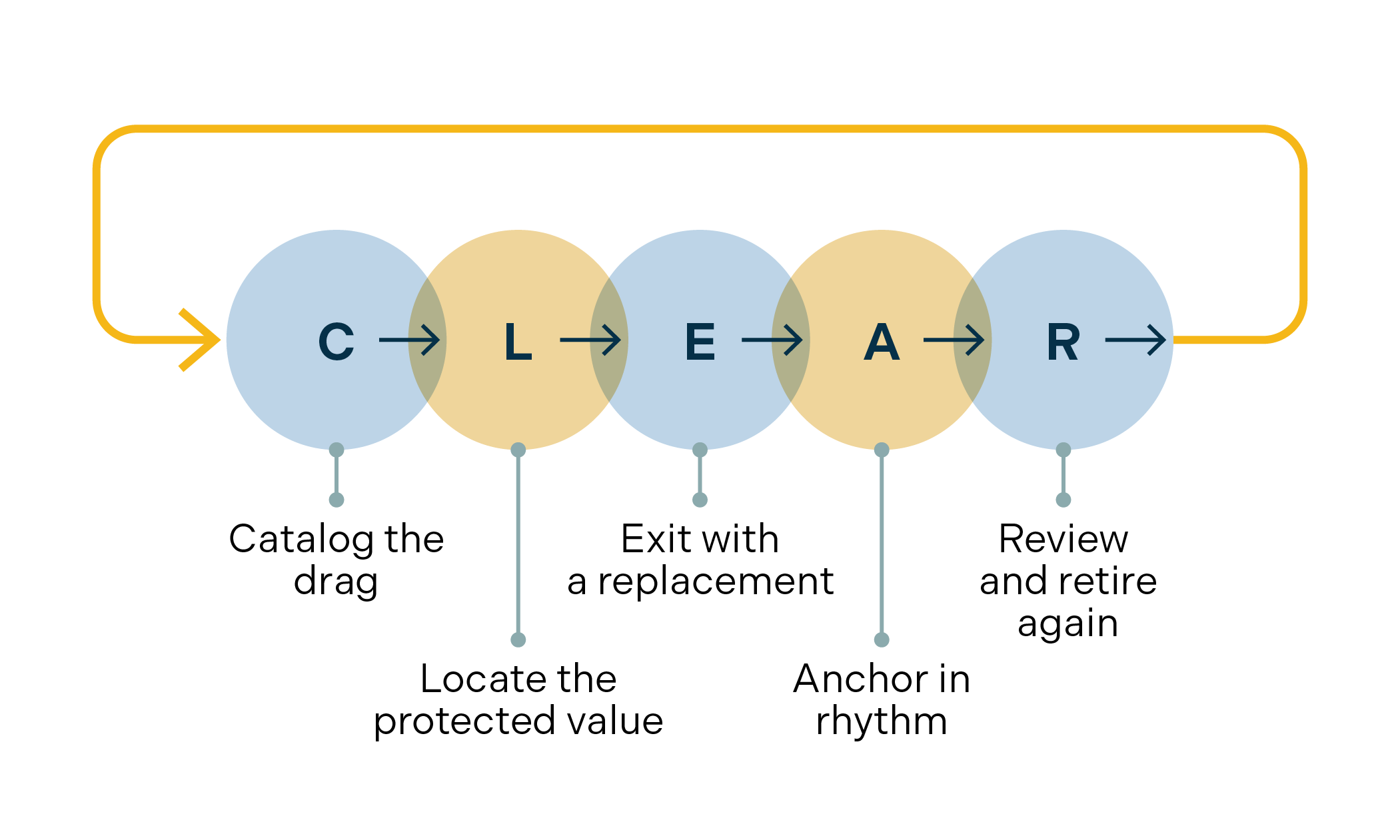
A practical framework: the CLEAR unlearning cycle
Unlearning has to be operational—specific, owned, and repeatable. The CLEAR cycle is designed to make “subtraction” a leadership capability, not a slogan.
C — Catalog the drag
Start with evidence, not opinions. Identify routines that consume time without improving decision quality.
Look for:
recurring “FYI” email chains
meetings that exist to “align” rather than decide
approvals that are routinely rubber-stamped
manual checks that duplicate system controls
Your goal is a short, visible inventory of friction.
L — Locate the protected value
Every control exists for a reason. Name the reason clearly.
Was it protecting:
cash leakage?
regulatory compliance?
reputational exposure?
quality failures?
If you cannot name the value it protects today, it is a prime candidate for retirement.
E — Exit with a replacement
Unlearning fails when leaders remove a step but don’t replace the safety it provided. The answer is not “no control.” The answer is lighter control.
Examples:
replace a committee approval with a threshold rule (e.g., managers decide up to X)
replace three signatures with one accountable owner + audit sampling
replace weekly reporting with a shared dashboard + exception alerts
The principle: preserve the value, not the ritual.
A — Anchor in rhythm
Old routines return when the operating cadence stays the same. Hardwire the new approach into how the organization runs.
Anchor into:
weekly business reviews
project gates
delegation of authority
performance routines
forum agendas (“decide” vs “update”)
If the rhythm doesn’t change, the old behavior will reassert itself—quietly, then completely.
R — Review and retire again
Unlearning is not a one-off clean-up. It’s a recurring discipline.
Set a 60–90 day review:
What did we stop?
Did the risk increase?
Did cycle time improve?
What can we retire next?
This is how you convert unlearning into a permanent operating muscle.
Unlearning works when leaders reward “clean stops” the same way they reward launches. If stopping is politically unsafe, the organization will keep everything alive—and starve what matters.
What “good” looks like
Organizations that unlearn well show behavioral signals you can observe:
From exception-by-influence → exception-by-rule Fewer “special approvals,” more clear guardrails.
From control theater → risk-based discipline Lighter governance, tighter on what actually matters.
From more reporting → fewer decision loops Meetings produce decisions, not motion.
From escalation reflex → empowered execution Teams move faster because boundaries are explicit.
A practical test: if you removed 20% of internal reporting tomorrow, would performance drop—or would clarity increase?
How to execute: six steps that don’t paralyze delivery
Pick one value stream (procurement, hiring, onboarding, order-to-cash).
Build a drag register: list the top 10 routines that slow it down and estimate time/cycle impact.
Publish a stop list: choose 3 items to retire immediately.
Install the replacement mechanism: thresholds, sampling, dashboards, or revised decision rights.
Rebuild the manager role: managers must coach the “new path,” not reintroduce the old one “just in case.”
Run a subtraction scorecard: track cycle time, rework, and controls retired.
Risks and trade-offs
Shadow process risk: teams keep the old steps privately. Mitigation: make the new path materially faster and formally endorsed.
Cultural misread: fewer meetings can be misinterpreted as lower seriousness. Mitigation: frame the shift as freeing leadership time for high-value decisions and relationships.
Over-correction: removing a control that was genuinely protective. Mitigation: use transitional sampling and clear exception triggers.
Leadership questions
What are we still doing because it once saved us—rather than because it still serves us?
Where do we confuse activity (emails, meetings, approvals) with control?
Which controls exist mainly to avoid blame, not to protect value?
Have we explicitly authorized teams to stop the old work—or did we just add new work on top?


.svg)