The Paradox of Digital Simplicity: Why Effortless Experiences Are the Hardest Thing to Engineer
November 13, 2025
8 min read
Organizations rarely struggle because they lack technology. They struggle because they buy "simple" tools and quietly pass the complexity on to the people using them
Key takeaways
Simplicity is not the absence of complexity. It is complexity that someone has deliberately absorbed, so the person at the front never has to.
Adding more tools to feel modern usually does the opposite. Each one looks simple in isolation while the system as a whole grows harder to use.
The failure mode is complexity transfer: pushing the organization's internal complexity onto employees and customers instead of engineering it away.
Treat simplicity as a design and architecture discipline, measured by how effortless work feels at the edge, not by how much technology sits behind it.
Across the GCC, digital transformation is a board-level priority. Governments are pursuing digital-first agendas, family groups are modernizing legacy operations, and enterprises are investing heavily in cloud, analytics, automation, and AI. The expectation is intuitive: more technology should mean more efficiency, more automation should mean faster execution, and more capability should mean better outcomes.
Many organizations experience the reverse. Despite larger technology budgets, work slows down, decisions get harder, and employees find themselves moving through several systems to do what one used to handle. This is the paradox of digital simplicity. The tools meant to simplify the organization often add new layers of friction, because the hard part of simplicity was never done. Real simplicity, the kind that makes an experience feel effortless, is the most complex thing an organization can build. It requires someone to take on the difficulty deliberately rather than passing it downstream.
Share
The real problem leaders underestimate: complexity transfer
Most organizations treat complexity as the natural cost of growth, and they respond predictably: add another platform, build another integration, introduce another workflow, stand up another dashboard. Each decision is rational on its own. Together they produce something worth naming directly: complexity transfer, the friction created when an organization moves its internal complexity onto the people who use its systems rather than absorbing it by design.
The cost lands first on employees. Harvard Business Review's research found that workers toggle between applications and websites roughly 1,200 times a day, losing close to four hours each week simply reorienting after each switch. That is complexity made visible, an organization asking its own people to hold its fragmentation together by hand. It compounds at the system level too. The average company now runs more than a hundred separate software applications, and analysts estimate that close to a third of that spending is wasted on overlapping or barely used tools. The technology stack grows while the experience of work degrades.
Complexity transfer shows up in four recognizable forms. Platform proliferation puts multiple applications on top of overlapping functions, blurring ownership. Workflow inflation adds approvals, notifications, and handoffs rather than removing them. Integration dependency means every new tool raises the cost of keeping data and processes coherent. And decision fragmentation scatters information across systems until no one can name the trusted source of truth. The organization becomes digitally sophisticated and operationally cumbersome at the same time.
A better lens: absorb the complexity, do not expose it
High-performing organizations start from a different premise. The goal of technology is not to add capability; it is to remove effort at the point where work actually happens. The discipline is to decide who carries the complexity. In a well-designed system, the architecture carries it, so the employee and the customer do not. In a poorly designed one, the people carry it, so the architecture can stay messy. The simplest experiences in the world sit on top of the most disciplined engineering, not the least. A useful rule captures it: if a process is a mess before you digitize it, digitization does not fix the mess. It industrializes it and hands it to more people, faster.
The FLOW framework
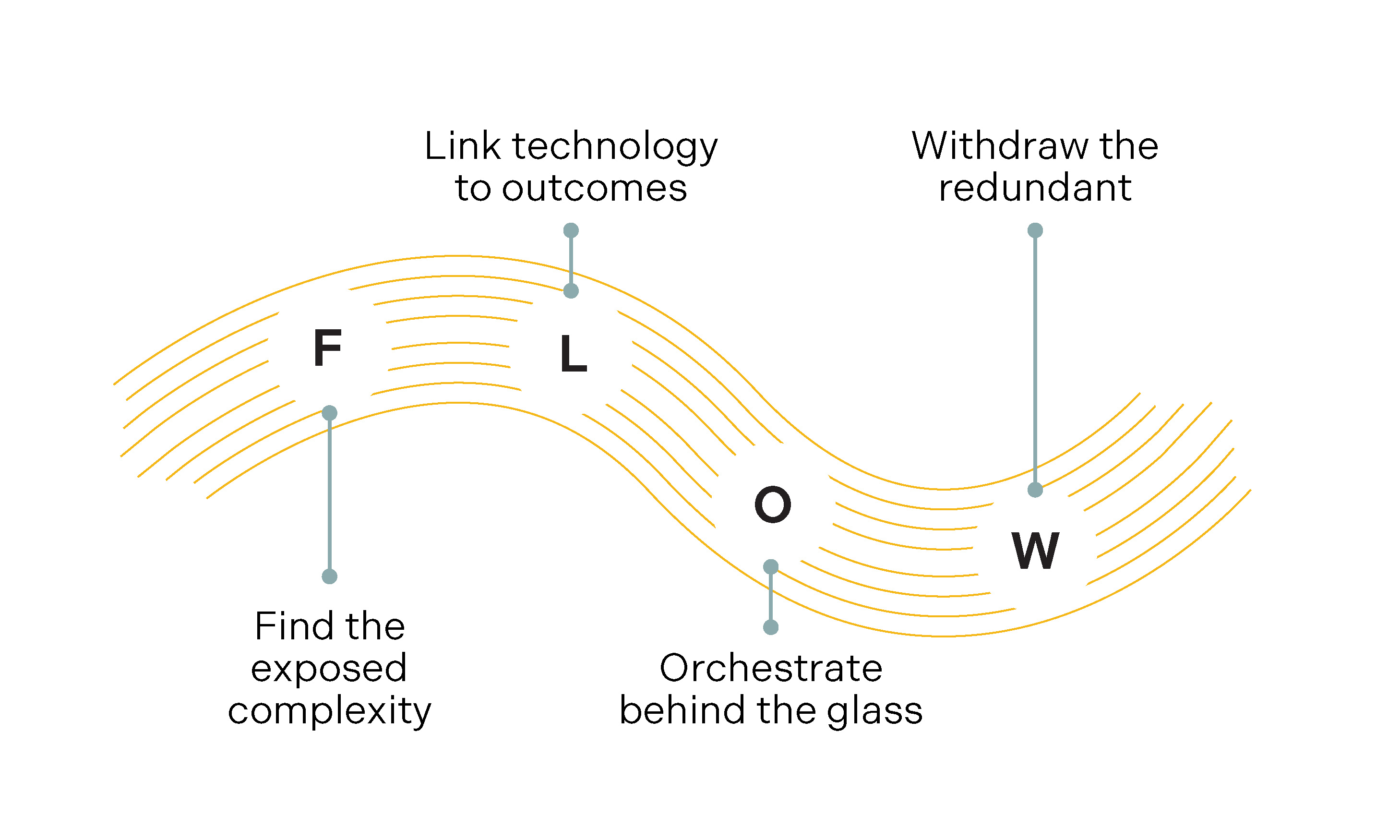
To stop transferring complexity and start absorbing it, leaders can apply FLOW.
F, Find the exposed complexity
Look for the places where the organization makes people deal with its internal mess: duplicate data entry, constant system switching, manual reconciliation between tools that should talk to each other. The aim is not to map systems but to find where the burden has been pushed onto humans.
L, Link technology to outcomes
Require every platform to justify the complexity it introduces by naming the outcome it improves, the decision it sharpens, or the process it accelerates. A tool that cannot make that case is not capability; it is overhead with a login screen.
O, Orchestrate behind the glass
Do the hard integration work where the user cannot see it, so the experience at the front stays simple. A single source of truth, connected workflows, and sensible defaults are what let a complex operation feel effortless. This is the move most transformations skip, because it is expensive and invisible, and it is exactly the move that separates real simplicity from cosmetic simplicity.
W, Withdraw the redundant.
Make subtraction an explicit discipline. Retire underused applications, overlapping tools, and obsolete reports on a schedule, and adopt a retire-before-acquire rule, because an organization that only ever adds will accumulate complexity faster than it creates value.
What good looks like
Organizations that absorb complexity rather than transfer it show clear shifts. Platform proliferation gives way to architectural discipline. Fragmented systems give way to connected pathways. Application ownership gives way to outcome ownership. And digital projects give way to a digital operating model. The difference is felt rather than presented: employees spend less time navigating systems, leaders spend less time reconciling versions of the truth, customers wait less, and work moves more naturally across the organization.
How to execute: five moves in the next 60 days
Run a complexity-transfer audit that maps where people, not systems, are absorbing the organization's friction, and quantify the lost time. Build a platform rationalization register that challenges every overlapping tool to prove its continued value. Take one high-volume process, such as procurement, onboarding, or customer service, and simplify it before any further automation. Establish architecture principles that govern how technology is acquired, integrated, and retired, with flow improvement as the test for any new platform. And measure flow rather than activity, tracking cycle time, throughput, rework, adoption, and decision speed, so you can tell whether technology is creating value or quietly creating drag.
Risks and trade-offs
The first risk is technology minimalism, where simplification slides into under-investment; the discipline is to simplify complexity, not capability. The second is local optimization, where one function streamlines while enterprise complexity rises; measure end-to-end processes, not isolated functional wins. The third is legacy attachment, where familiar systems survive on the strength of past investment; evaluate platforms on future value rather than sunk cost. The fourth is innovation accumulation, where new tools keep arriving while old ones never leave; enforce a retire-before-acquire rule.
Leadership questions
Which of our technologies create more complexity than value?
Where are we digitizing a broken process instead of redesigning it?
How much of our technology spend improves flow, and how much just adds administration?
If we removed a fifth of our applications tomorrow, what would actually break?
Are we measuring digital activity, or digital effectiveness?
The organizations that succeed at digital transformation will not be the ones with the largest technology stacks. They will be the ones that create the greatest flow, because transformation was never really about technology. It is about deciding to carry the complexity yourself, in the architecture and the design, so that people, decisions, and value can move through the organization without friction. The goal is not digital sophistication. It is an organization that feels simple to work in and to buy from, precisely because someone did the hard work of making it so.
Share
References
Harvard Business Review (2022). How Much Time and Energy Do We Waste Toggling Between Applications? Study of 137 users across three Fortune 500 companies; workers toggled between apps and websites roughly 1,200 times a day, losing close to four hours a week (about 9% of work time) reorienting.
BetterCloud / Statista (2024). Average organization runs roughly 106 SaaS applications. Industry analysis (Gartner, Zylo) estimates close to a third of SaaS spend is wasted on redundant or underused tools, with average license utilization near 49%.


.jpg)
.svg)