For fifty years the GCC and Africa imported their strategy. The institutions now pulling ahead have stopped, and started authoring frameworks built for the structures they actually run.

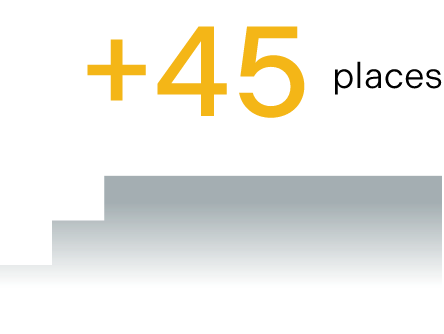
On the Global Economic Diversification Index, the UAE has climbed more than 45 places since 2000, one of the largest moves of any economy on earth (Global EDI 2026). It did not happen by adopting a template. It happened by authoring one.
Strategy in the Gulf used to arrive in someone else’s deck. National visions, operating models and transformation roadmaps were adapted from playbooks built for other economies, other institutions and other ways of making decisions. That era is over. The question across the GCC, and increasingly across Africa, is no longer which global framework to adopt, but why the framework was never built for the region in the first place. A strategy imported wholesale is a borrowed map of someone else’s terrain, marking its roads with great confidence while showing nothing of the ground beneath your own feet. The shift now under way, from imported strategy to authored strategy, will decide who leads this decade.
Borrowed strategy passes every test in the boardroom and fails the only one that counts, which is delivery. The bill lands two years later, and it lands on you. A government or sovereign-linked entity adopts an operating model that quietly assumes institutions, talent and data the country has not yet built, then discovers the gap at rollout, where fixing it costs the most. A family enterprise installs textbook governance that never accounts for who actually owns the decision, so the org chart looks immaculate while the business runs on the old wiring beneath it. A regional enterprise imports a model tuned to another market’s problems and spends its energy solving challenges it does not have, while the ones it does have go unmanaged. It is the same failure in three forms: the plan clears approval and dies on contact with context.
The region told itself a story, that it imported expertise because the local capability was not ready. That was once partly true. Today it is the single most expensive assumption a leader can still hold.

“Global best practice” is never context-free; it encodes silent assumptions about how institutions behave, how fast capital moves, how labour markets clear and how decisions travel. Lift a model built on one set of assumptions and drop it onto another, and the gap does not appear in the strategy. It appears in execution, as drift, rework, and programmes that quietly run aground.
There is a reasonable case for borrowing what already works, and most boards have heard it: why reinvent an approach that well-tested frameworks have already proven elsewhere? That logic held while markets were converging on a single model and the winning moves looked much the same in every capital. It fails the moment context becomes the differentiator, because an imported framework carries within it the assumptions of the place that built it, including its depth of capital, the shape of its labour market, the strength of its institutions and its standing in the world. Applied where those assumptions do not hold, it does not fail quietly; it solves the wrong problem with great conviction. That is why borrowed strategy so often disappoints. The fault lies not in the execution but in the quiet mismatch between the model’s assumptions and the ground on which it is asked to stand.
There is a name for the alternative. We call it strategic authorship: the discipline of building strategy from your own institutional reality rather than retrofitting one designed elsewhere. It begins from the local readiness curve and builds forward, instead of importing the destination and assuming the road. The clearest evidence is that successful strategies rarely resemble one another. The UAE built its diversification around its own endowment, Rwanda its institutional renewal around its own history, and Estonia its digital state around its own constraints, and none of the three borrowed from the others. What they held in common was never a shared model but a shared discipline: each was authored to its own context rather than imported from someone else’s. The same logic is reshaping Africa, where the digital strategies that endure are those built on actual local ecosystem maturity, not the ones airlifted in at full scale and abandoned at first contact.
The lesson is blunt. The plan built for the region it serves is the only plan that survives it.
a score above
The UAE’s climb of more than 45 places on the Global Economic Diversification Index since 2000, to a score above 100, followed an approach built for its own structures rather than adopted from one. The diversification did not produce the authorship; the authorship produced the diversification. (Global EDI 2026)
of GCC GDP
Non-oil activity now accounts for 73.2% of GCC GDP, the result of decades of regionally fitted industrial and trade policy rather than a single imported model. (GCC-Stat, H1 2025)
ninth-largest economy
The GCC is now the world’s ninth-largest economy at $2.3 trillion, large enough that a mismatched strategy no longer fails quietly. (GCC-Stat, 2024)
readiness
National AI-readiness varies sharply by local ecosystem maturity rather than by ambition, which is precisely why a strategy authored from local evidence outperforms the same blueprint transplanted from a different starting line. (Oxford Insights, Government AI Readiness Index)
Source: Global EDI 2026.
Hunt the borrowed assumptions.
Take your current operating model and mark every assumption it makes about institutions, talent, data and decision speed. The ones that hold elsewhere but not here are your real risk register, and nobody has named them yet.
Make context a gate, not a footnote.
Before any framework is adopted, force it through three tests: your ownership and governance structure, your true talent and data maturity, and the speed at which decisions actually move. A framework that fails the test will fail in delivery, only later and more expensively.
Author your signature frameworks.
Pick the two or three decisions your institution makes again and again, and build a framework for each from your own context. Owned frameworks compound while borrowed ones depreciate: one is an asset, the other a rental.
Imported strategy will keep arriving in confident decks. The institutions that win this decade will be the ones that put context first, because in the GCC and across Africa the only strategy worth having is the one built to survive the place it is used.
Sources: Global Economic Diversification Index 2026; Statistical Centre for the GCC (GCC-Stat), “GCC in Numbers,” February 2026; Oxford Insights, Government AI Readiness Index.
The Synarchy Edge is Synarchy Consulting’s monthly thought-leadership series on the structural shifts — in strategy, capital, technology, talent and governance — reshaping how institutions across the GCC and Africa compete and endure.