AI Without the Jargon: What Really Changes for Leadership Teams (and What Doesn’t)
July 29, 2025
8 min read
Boards don’t need more acronyms; they need clarity. AI will not “transform” your organization because you bought a tool. It transforms your organization when it changes how work moves—who does what, when decisions get made, and which risks are explicitly owned.
Key takeaways
Treat AI as an operating model change, not a tech upgrade. AI’s primary impact is workflow redesign—compressing cycle times and forcing clearer handoffs—not “content generation.”
Keep judgment human; make guardrails explicit. AI expands options; leaders still own trade-offs, ethics, and “stop” decisions.
Data hygiene beats model sophistication. If definitions, permissions, and lineage are weak, AI will scale confusion—not insight.
Escape “Pilot Purgatory” with scale-or-kill gates. Run three 30-day workflow pilots tied to cycle time and rework, not excitement.
Why This Matters Now
Across the GCC, AI is arriving in the same season as everything else: national transformation agendas, productivity pressure, and tightening regulatory expectations. Adoption is rising fast, but value is not keeping pace—because many organizations are modernizing tools while leaving the operating system untouched. PwC’s Middle East workforce research shows strong momentum toward AI usage, but also the familiar organizational gap between experimentation and sustained value.
The pattern is consistent: the board sees a great demo, yet Monday morning still runs on long approval chains, unclear ownership, and inconsistent data.
Share
The Real Problem: Bolting High-Velocity Tools onto Low-Velocity Work
AI initiatives rarely fail because the model is “not good enough.” They fail because AI exposes friction you already had:
Handoffs don’t match the new speed. If drafting is instant but approvals still wait for a weekly committee, the bottleneck simply moves.
Data disagreements become performance problems. If “churn” means three different things across Sales, Finance, and Product, AI can’t reconcile truth—it will remix inconsistency at scale.
Leaders inherit “decision risk,” not just cyber risk. People act on outputs they don’t understand, or they ignore outputs and create shadow usage outside governance.
This is why AI should be treated like a throughput lever: it compresses time, so any ambiguity in decision rights, standards, or accountability becomes painfully visible.
A Better Lens: AI as Throughput + Judgment
A useful way to cut through hype is to separate the two worlds AI creates:
Human responsibility: choose trade-offs, accept risk, protect reputation, uphold values.
When leadership teams confuse the two, AI becomes either a toy (“nice demo”) or a threat (“we can’t trust it”). The winning stance is simpler: use AI to accelerate work, and use governance to protect judgment.
The GRIP Model: A Practical Operating Blueprint
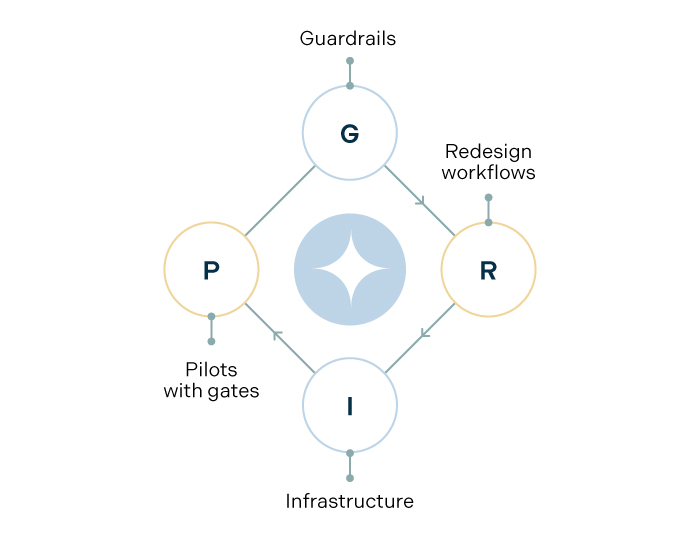
To move from “AI tourism” to measurable value, use GRIP—four moves that make AI executable.
G — Guardrails (keep judgment human)
Define what must never be automated (e.g., sensitive HR decisions, regulatory commitments, external brand statements without review). Establish “stop rules” for low confidence outputs and escalation paths for exceptions.
R — Redesign workflows (remove steps, don’t just automate tasks)
If AI creates usable insight earlier, redesign the sequence. The ROI comes from faster decisions and fewer loops—not from faster drafts. This is where meeting load, review steps, and handoffs must shrink.
I — Infrastructure (data hygiene and access)
AI amplifies whatever you feed it. If your data foundations are weak, AI scales noise. NTT DATA’s research highlights how outdated/inadequate infrastructure constrains innovation—AI doesn’t fix that by itself.
P — Pilots with gates (scale or kill)
Every pilot needs a Day-30 decision: scale, iterate, or stop. No zombie experiments. If cycle time or rework doesn’t move, the pilot is theater.
What Good Looks Like
When AI is truly embedded, behavior shifts—not slide quality.
From “status updates” → “trade-off decisions.” Meetings focus on choices, not data gathering.
From “central analytics” → “owned outcomes.” If Finance uses machine forecasting, Finance owns the variance—not IT.
From “shadow AI” → “instrumented adoption.” The official tools are faster and safer than workarounds, so usage becomes visible and governable.
How to Start: Three 30-Day Tests
Don’t start with “enterprise AI.” Start with three workflows where time and rework are measurable.
Triage (Operations): classify and route requests faster
Metric: time to first meaningful action
Draft (Corporate Services): first drafts of RFPs, policies, job descriptions
Metric: time to final version + rework rate
Synthesis (Strategy/Risk): compress regulatory/market signals into decision briefs
Metric: % of inputs that are decision-grade vs. noise
Rule: baseline first. If you can’t measure today’s cycle time, you can’t prove AI improved it tomorrow.
Risks and Trade-offs
Speed vs. trust: Move too fast and you invite hallucinations and reputational damage.
Mitigation: human-in-the-loop for external outputs; log assumptions on critical uses.
Central control vs. local ownership: Centralize too much and you create bottlenecks; decentralize too much and you create chaos.



.svg)