Coffee, Conundrums, and Clarity: Designing for Strategic Serendipity in a Hyper-Scheduled World
August 26, 2025
8 min read
Modern strategy is often optimized for convergence, not discovery. Here is how leaders can engineer the “coffee break breakthrough” without losing operational discipline.
Key takeaways
Treat serendipity as a strategic input, not a lucky break. Breakthroughs often come from “incubation”: focused effort followed by deliberate mental space—not continuous grind.
Informal conversations surface truth faster than formal meetings. Unstructured environments reduce hierarchy and consensus theater, allowing weak signals to surface before they become crises.
Design for structured serendipity. Use the BREW model to create repeatable conditions for insight without turning them into bureaucratic rituals.
Capture beats charisma. An informal insight only creates value if it enters a formal testing loop. If it stays on the napkin, it is just noise.
Why This Matters Now
Strategy work in 2026 is harder than it looks on a slide. Markets shift with algorithmic speed. Transformation agendas are multi-stakeholder by default. And across the GCC, leadership teams are navigating complexity that doesn’t respect functional boundaries—digital, regulation, talent nationalization, and customer expectations are colliding in the same week
The reflex response to complexity is to add structure: more steering committees, more pre-reads, more alignment forums, and more “governance.” In moderation, structure protects execution. In excess, it creates a hidden fragility: the organization becomes excellent at agreeing on what it already knows—and poor at discovering what it doesn’t.
This matters acutely in the Gulf. Relationship-based business is not a cultural detail; it is a delivery mechanism. When every interaction gets digitized into a Zoom slot with a rigid agenda, you don’t just lose spontaneity. You lose the safe, informal spaces where people share inconvenient truths early—before they become public failures.
Share
The Real Problem: The Convergence Trap
Formal meetings are optimized for safety. Roles harden. Language becomes careful. Juniors wait for signals from seniors before speaking. Disagreement—especially in high-context environments—tends to be handled indirectly to preserve face and relationships. None of this is incompetence. It is human nature.
The unintended outcome is a convergence trap: forums designed to generate insight end up generating polite agreement. Teams leave with action items and a sense of progress, but not necessarily better thinking. Meanwhile, the real strategic inputs live in the “in-between” moments: the customer frustration that hasn’t hit the NPS dashboard yet, the operational workaround that never makes it into the monthly pack, the competitor behavior that “feels different” but can’t be proven in a chart.
These signals don’t surface when the room is performing competence. They surface when the stakes drop—walking back from the pantry, in the car after a site visit, or over coffee.
A Better Lens: Serendipity as a System
Serendipity is not randomness. It is a system with inputs. Research on the incubation effect shows that stepping away from linear problem-solving can improve solution quality because the brain continues processing in the background—making connections you won’t reach through brute force. The implication for leaders is practical: great strategy teams don’t choose between discipline and creativity. They alternate.
If you only run Focus Mode, you get efficiency—often in the wrong direction. If you only run Incubation Mode, you get ideas—often without closure. The advantage comes from designing both modes into the operating rhythm.
The Framework: BREW Structured Serendipity
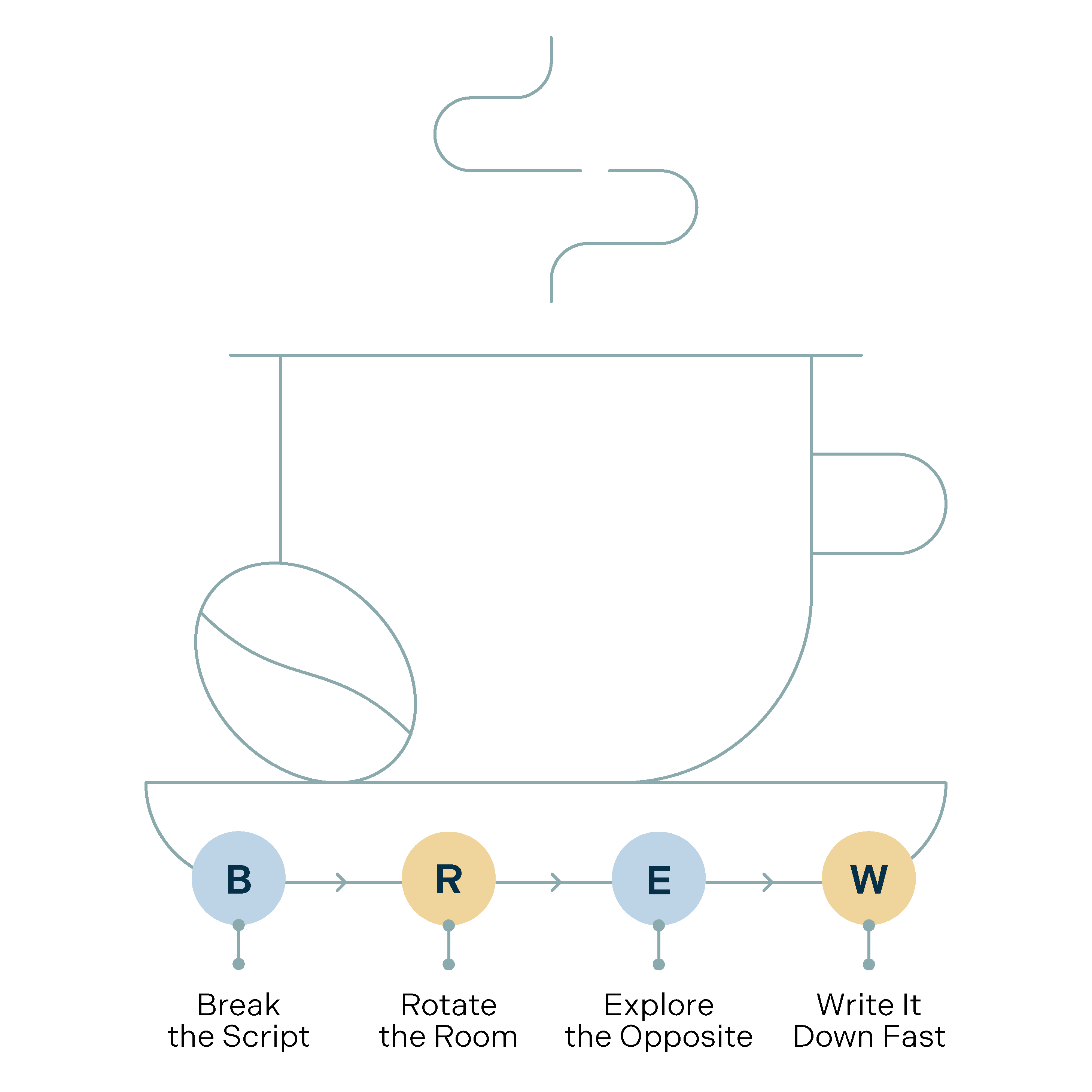
To engineer “coffee break breakthroughs” without turning them into another ritual, use BREW—a lightweight design for informal insight that still produces outcomes.
B — Break the Script (Briefly)
Schedule unstructured time on purpose. No decks. No updates. No “round-the-table.” One question only: What are we missing? The constraint creates focus without suffocation.
R — Rotate the Room
Invite perspective, not hierarchy. In formal meetings, the HIPPO (Highest Paid Person’s Opinion) dominates—often unintentionally. In BREW sessions, rotate in frontline operators, customer-facing staff, junior analysts, and adjacent functions. Diversity of input is oxygen for decision quality.
E — Explore the Opposite
Introduce one provocation: If we did the opposite of our current approach for 30 days, what would we learn? This interrupts cognitive fixation. It forces the team to defend the strategy on its merits, not its momentum.
W — Write It Down Fast
Capture the spark before it evaporates. Use a micro-format:
Spark → Why it matters → Next test (by when).
If it can’t be expressed simply, it’s not ready—or it’s not real.
What Good Looks Like
When structured serendipity becomes real, you see it in behavior—not in posters.
From agenda compliance → insight velocity. People raise half-formed observations early, and the organization gets smarter sooner.
From siloed certainty → cross-pollination. Marketing understands a supply bottleneck because they heard it firsthand—not because they read it in a report.
From defending the plan → interrogating reality. Leaders get comfortable asking, “What if we’re wrong?” without treating it as disloyalty.
How to Execute: The Napkin-to-Roadmap Loop
The napkin isn’t the outcome. The system is.
Capture: Log BREW outputs in a shared Insight Backlog.
Triage: Monthly, pick the top three worth testing (not debating).
Test: Run low-fidelity experiments—customer calls, prototypes, shadow pilots.
Commit: Convert validated insights into formal decisions and priorities.
Close: Retire the rest. Keep the learning, not the clutter.
Risks and Trade-offs
The “all talk” risk: Informal sessions become complaint fests.
Mitigation: the Write-It-Down rule—no “next test,” no airtime.
Exclusion risk: Informal networks can become closed circles.
Mitigation: rotate the room intentionally; track participation like a governance metric.
False positives: Ideas sound brilliant over caffeine and fail in reality.
Mitigation: never go from coffee to execution—go from coffee to testing.
Leadership Questions
When was the last time a strategic assumption changed because of an informal conversation?
Are our calendars so optimized for “output” that we’ve eliminated the conditions for “input”?
Do we have a mechanism to capture hallway ideas—or do we let them die because they didn’t fit the agenda?
Where are we confusing “alignment” (coordination) with “insight” (better choices)?
If we did the opposite of our current top priority for 30 days, what might we learn about our blind spots?
Your Next Cup of Coffee
If you want a better strategy, don’t only improve your workshops. Improve your conditions for truth.
This week, try three moves:
Replace one status meeting with a No-Deck Coffee Forum.
Create a shared Insight Backlog and treat it like a real pipeline.
Run one Opposite Question on a live strategic decision.
In a world obsessed with precision, the sharpest clarity sometimes arrives via detour. When you design for those detours—then capture and test what they reveal—serendipity stops being a happy accident.


.svg)