The Consultant’s Compass: Navigating the GCC’s Execution Era (2026)
August 5, 2025
8 min read
In the GCC, the era of “strategy as product” is ending. The next competitive advantage is simpler—and harder: execution with impact.
Key takeaways
The region has pivoted from vision to velocity. Strategy is table-stakes; the operating model that delivers it is the differentiator.
Indecision is now an economic risk. The “Paralysis Paradox” (more data, slower decisions) is quietly taxing growth through delay and rework.
Consulting is being redefined by co-creation and measurable outcomes. Clients want implementation rigor and capability uplift—not decks and handoffs.
Sovereign AI and localized capability centers are rewiring talent. Agility and specialized skills will beat tenure; governance must keep up.
Why This Matters Now: The Great Pivot
The GCC spent the last decade building ambitious blueprints—Vision 2030, We the UAE 2031, and peers across the region. Those strategies did what they needed to do: they established direction, mobilized capital, and created national momentum.
But late 2025 into 2026 signals a phase shift. Boards aren’t being judged on the elegance of their plans anymore. They’re being judged on whether their organizations can execute—fast, consistently, and at scale. Macroeconomic conditions remain supportive, but the new constraint is internal: decision latency, bureaucratic friction, and operating models designed for a slower era.
If your organization is still optimized for approvals, not outcomes, execution will stall—no matter how compelling the vision looks on stage.
Share
The Execution Constraint: The Paralysis Paradox
Most organizations assumed more data would create better decisions. In practice, many are seeing the opposite: more dashboards, more stakeholders, more options—and slower closure.
This is the Paralysis Paradox: as choices multiply, decision velocity collapses. Teams hedge. Workstreams run in parallel “just in case.” Routine issues escalate upward to avoid risk. The organization keeps moving, but direction becomes blurry—and cost compounds through rework and delay.
In conglomerate-heavy GCC environments, multi-entity complexity amplifies the problem. Every additional sign-off, steering committee, and alignment meeting creates more decision nodes—and each node adds friction.
The Execution Tax: Organizational Drag
Drag isn’t a motivation issue. It’s structural. It shows up as needless interactions, duplicated controls, and governance that is everywhere at once.
In 2026, drag typically comes from three sources:
Excessive collaboration: meetings and messaging replacing decisions
Resource thinning: too many initiatives, too little focus
Over-governance: controls multiplying without protecting additional value
Drag doesn’t just waste time—it changes behavior. Leaders avoid ownership. Teams optimize for approvals. Execution becomes performative rather than productive. The uncomfortable truth: you can’t out-strategize drag—you have to remove it.
A Leadership Lens: From Visionary Architecture to Delivery Architecture
If the last decade was about drafting the blueprint, 2026 is about building the site discipline: decision rights, delivery cadence, and measurement that reveals progress early.
A practical rule for leadership teams: If a forum cannot justify its existence by improving decision speed or decision quality, it is drag—by definition.
That’s the mindset shift behind the new execution era: less narration, more closure.
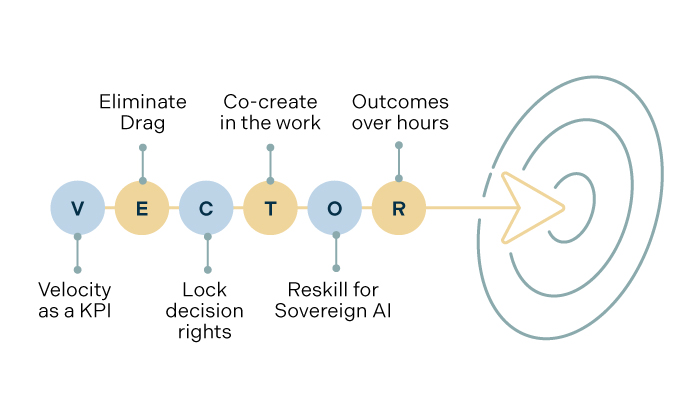
The Framework: VELCRO (A Compass for Execution)
To translate vision into velocity without chaos, use VELCRO:
V — Velocity as a KPI
Track decision cycle time (question raised → decision made → decision executed). If it’s expanding, your operating model is the bottleneck.
E — Eliminate Drag
Cull zombie projects, retire redundant approvals, and simplify reporting that doesn’t change decisions.
L — Lock Decision Rights
Clarify who decides vs. who advises. Fewer “veto” roles. More explicit thresholds and delegation.
C — Co-create in the work
Shift from “handover consulting” to embedded delivery: build with operators, shorten feedback loops, leave capability behind.
R — Reskill for Sovereign AI
Treat AI as infrastructure (data, governance, talent) not theatre (pilots that never scale).
O — Outcomes over hours
Buy measurable improvements—cycle time, throughput, adoption—not activity and slide volume.
How to Execute in 30 Days
Run a Drag Audit: list top 10 decision nodes and meeting forums; kill or redesign the bottom three.



.svg)