Consulting with a Conscience: What Happens When You Say ‘No’ to a Lucrative Engagement
March 4, 2025
8 min read
Key takeaways
• Treat client selection as governance: make acceptance and decline decisions consistent, documented, and repeatable.
• Say no to readiness gaps, not just “bad actors”: many harmful engagements are well-intentioned but structurally mis-timed.
• Protect the trust premium: in advisory, reputation compounds; one misaligned engagement can dilute it quickly.
• Use a decision framework to remove emotion and prevent rationalizing “one-off” exceptions.
The advisory market is getting louder, faster, and more lucrative—especially around transformation. At the same time, family-owned enterprises remain a dominant engine of the global economy. Commonly cited estimates, often attributed to the Family Firm Institute and repeated by universities and research summaries, put family firms at roughly 70–90% of global GDP.
That scale changes the ethics of consulting. When a consultant accepts a major engagement with a family enterprise, the effects can spill beyond a single P&L—into employee livelihoods, supplier ecosystems, community reputation, and multi-generational continuity. The most consequential decision often happens before discovery begins: whether to take the work at all.
The hardest “no” is rarely the obviously unethical mandate. It is the well-funded engagement where the stated intent is reasonable, but the organization is not prepared—governance is weak, accountabilities are blurred, and the work required is cultural and structural, not technical. In those cases, “yes” can become a polite way of participating in predictable failure.
Share
The real problem leaders underestimate: integrity erosion by exception
Most firms don’t compromise their values in a dramatic moment. They compromise through incremental exceptions:
“It’s a prestigious logo.”
“We’ll steer them once we’re inside.”
“The scope is limited; the risk is manageable.”
“Everyone else would take it.”
Over time, exceptions become a pattern. And patterns become a brand.
When the pipeline is tight and the engagement is lucrative, principled selection often drifts into revenue-driven justification. Delivery quality bends with it. Teams feel the dissonance. Partners start negotiating with themselves. The firm quietly trains its market that boundaries are flexible—at a price.
For family enterprises—where trust is a strategic asset—this is especially damaging. Trust takes decades to build and one crisis to puncture. And once a consultant’s name is attached to a controversial outcome, the reputational half-life is long.
A practical framework: the FENCE test
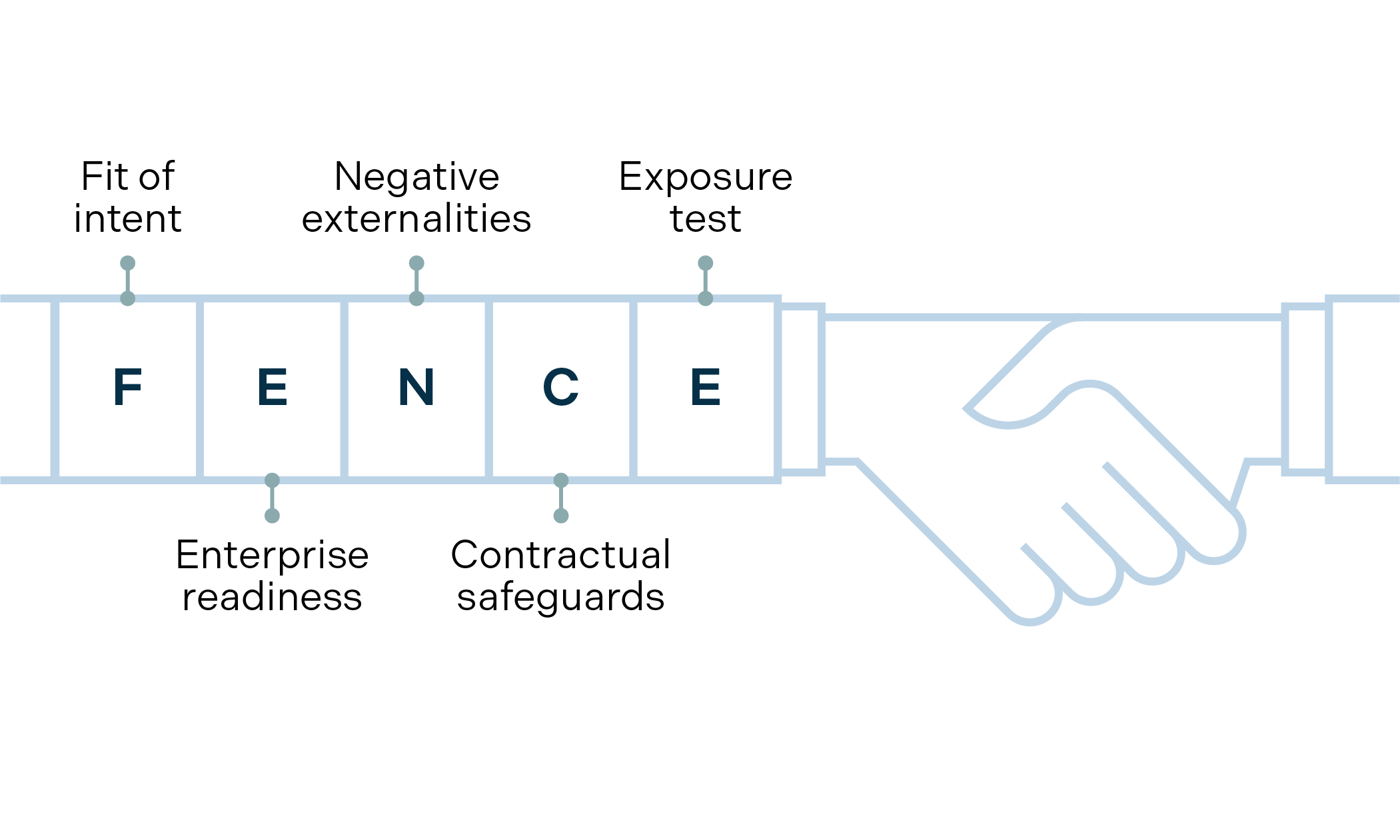
To keep the “no” decision professional—not personal—use a repeatable filter. One option is FENCE, a five-part test for high-stakes advisory engagements. The name is deliberate: a fence is not a wall. It doesn’t block opportunity. It defines the boundary that protects what matters.
F — Fit of intent
What is the client actually buying? If the engagement is designed to manufacture credibility, provide cover, or pre-commit a conclusion, the work is not advisory—it is narrative engineering. If you can’t say the purpose plainly, you should pause.
E — Enterprise readiness
Is the operating system ready for the change being purchased? Readiness is not enthusiasm. It’s decision rights, data discipline, leadership capacity, and the ability to absorb change without breaking execution. In the GCC, “pilot-heavy, scale-light” transformation patterns are well-documented in AI adoption—useful as a broader cautionary tale about rushing into high-visibility programs without the foundations.
N — Negative externalities
What second-order harm could the engagement create—culturally, reputationally, legally, or socially? Ethics is not only about intent; it is also about predictable consequences. If the likely outcome includes workforce burnout, reputational exposure, or governance destabilization, “yes” should require a redesign—not optimism.
C — Contractual safeguards
If the work is worth doing, can it be fenced with guardrails? Examples: independence of findings, evidence standards, clear escalation rights when ethics are pressured, and an explicit ability to exit if scope shifts into misrepresentation. Safeguards turn moral discomfort into operational terms.
E — Exposure test
Assume the engagement becomes public. Could you explain it simply—without defensiveness—to your team, a regulator, or the market? If the only defense is “it was in scope,” you have already lost.
The FENCE test doesn’t require moral grandstanding. It requires clarity. And clarity makes decision-making faster.
What “good” looks like
Firms that operationalize ethical selection show observable behaviors:
Non-negotiables are written. Not a manifesto—just clear red lines.
“Can we deliver?” is separated from “should we?” Capability is not legitimacy.
Decisions are documented. A one-page record reduces “exception creep.”
Teams feel protected. When boundary pressure appears mid-engagement, escalation is real—and leadership backs it.
This is how conscience becomes an operating capability, not a personality trait.
How to execute: a lightweight “No-Strategy” operating rhythm
1.Codify non-negotiables
Objective: remove ambiguity under pressure. Output: a one-page policy (sectors, behaviors, requests you will not support).
2.Run FENCE before pricing and staffing
Objective: avoid late-stage ethical discomfort. Output: a short screening note: yes / yes-with-guardrails / no.
3.Design guardrails for “yes-with-guardrails”
Objective: reshape the work into something responsible. Output: scope clauses covering independence, evidence integrity, confidentiality, and exit triggers.
4.Standardize the decline script
Objective: say no without drama. Output: a brief message framed around fit and readiness, not judgment.
5.Install an internalescalation mechanism
Objective: protect teams from boundary pressure midstream. Output: named partner-level escalation + response protocol.
6.Quarterly portfolio review
Objective: ensure your “yes” decisions compound into the brand you want. Output: a simple map of aligned work vs. risk-heavy work.
Risks and trade-offs
• Short-term revenue volatility: Mitigate through diversified pipeline strategy and realistic capacity planning. • Misinterpretation by prospects: Mitigate with neutral language and readiness framing. • Internal inconsistency: Mitigate by documenting decisions and reviewing patterns quarterly.
Leadership questions
• Which engagements would we struggle to defend publicly—and why? • Where do we confuse “helping” with “enabling”? • What would our best people refuse to work on? • Which non-negotiables are real—and which are negotiable under pressure? • Are we building a portfolio we’re proud to explain?



.svg)