From Intent to Impact: How to Design Transformation That Doesn’t Lose Steam Midway
July 1, 2025
8 min read
Most initiatives don’t fail in the boardroom. They fade on Tuesday afternoons—when good intent meets old incentives, unclear ownership, and a calendar built for updates, not outcomes. Here is how GCC leaders can engineer momentum so transformation doesn’t leak away after the kickoff.
Key takeaways
Treat momentum as an operating design problem, not a motivation problem. The enemy is leakage: decision drift, ownership blur, and competing priorities.
Translate strategy into two artifacts that force action: a Decision Charter (who decides what) and a Value Path (how outcomes flow across teams).
Replace status cadence with execution loops. Use weekly decision notes, logged assumptions, and time-boxed pivot windows to prevent re-litigation and keep learning compounding.
Measure traction, not theatre. Track learning velocity (idea-to-test), decision cycle time, and retired work—not slide output and meeting attendance.
Across the GCC, transformation has become a permanent condition. National agendas, accelerated digitization, regulatory tightening, and fast-shifting customer expectations mean leaders are running multiple change programs at once. Yet the paradox is brutal: the more ambitious the portfolio, the more fragile momentum becomes.
Most programs don’t stall because the strategy is unclear. They stall because the organization keeps operating as if transformation is a side project—something to “manage” alongside business as usual. That assumption creates a predictable pattern: the kickoff is strong, the town hall is electric, and the first steering committee is well attended. Then the work meets the system—and the system wins.
When transformation isn’t designed into the operating rhythm, progress depends on energy. And energy is seasonal. Architecture isn’t.
Share
The Real Problem: Momentum Leakage
Kickoffs are intoxicating: big decks, bigger promises. Then gravity arrives—procurement cycles collide with sprint timelines, dependencies multiply, and nobody can answer the most dangerous question in transformation:
“Who can decide this today?”
Momentum rarely dies in one dramatic moment. It leaks through familiar cracks:
Decision drift. Issues circle through “alignment” meetings without closure.
Incentive mismatch. Teams are rewarded for local outputs while transformation demands end-to-end outcomes.
Calendar worship. Time is consumed by updates, leaving little capacity for problem-solving and delivery.
Re-litigation. The same debate returns each month in a new deck because assumptions and decisions were never logged.
When leaders label this as “resistance,” they often respond with more communication, more town halls, and more urgency. But the friction is usually not emotional. It’s mechanical. The transformation was launched—but not engineered.
The Design Principle: Make Progress the Default
Slogans don’t sustain change. Systems do.
High-performing transformations treat momentum like an operating-system property: built-in, repeatable, and resilient during busy weeks. The aim is not to make people care more. It is to make progress easier than stalling.
A practical rule:
If your transformation cannot show measurable movement in the first 30 days, it will likely demand persuasion for the next 300.
Momentum is not a mood. It’s a mechanism.
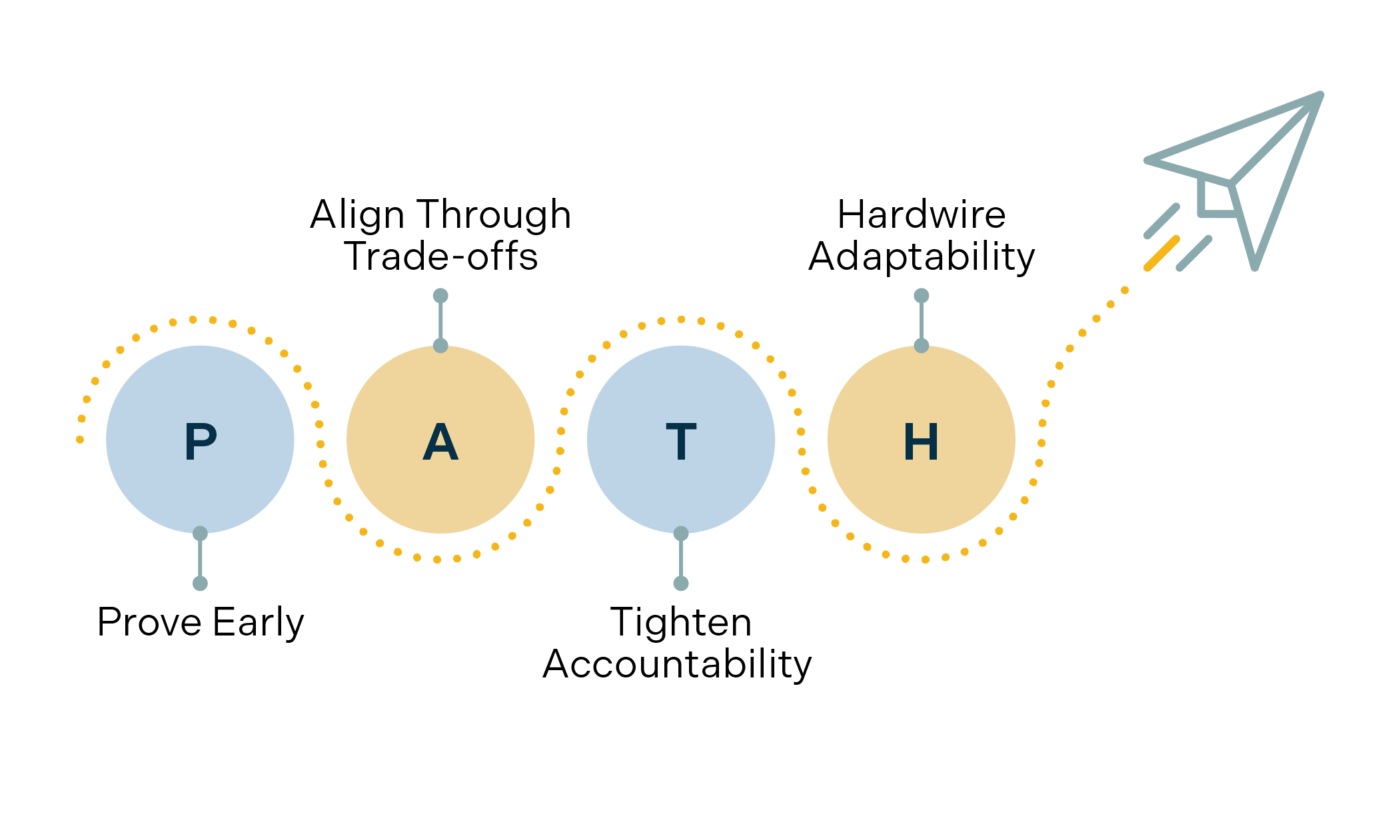
The Framework: The PATH Model
To convert intent into durable traction, use PATH—four moves that turn transformation into a delivery engine.
P — Prove Early
The first mile is where transformations quietly lose credibility. Don’t treat the first 30 days as a roadshow. Treat it as a build sprint.
Aim for three early proofs:
One customer outcome moved (even slightly).
One process simplified (a step removed, a handoff clarified).
One metric instrumented (so reality becomes visible).
Early proof is not about scale. It’s about signal: showing the organization that progress is real, measurable, and repeatable.
A — Align Through Trade-offs
Consensus is easy when nothing is at stake. Real alignment is visible in what you won’t do.
Create two artifacts that force trade-offs into daylight:
Decision Charter (one page).
Who decides, who advises, who executes, and who must be informed for the top workstream decisions.
Explicitly define what does not require escalation.
Value Path (one page).
How the outcome travels across teams—where it starts, where it queues, where it risks breaking.
The point is not beauty. It is friction visibility.
When the value path is explicit, handoffs stop eating your lunch. When decision rights are explicit, escalation stops being the default.
T — Tighten Accountability (With Enablement)
Accountability without enablement becomes blame. Enablement without accountability becomes theatre.
Install a weekly operating rhythm that has “teeth” and help:
Single-point ownership for each outcome (one named owner, not a committee).
Clear escalation routes (what gets resolved where, by when).
A weekly decision note (replacing the status deck):
the choice made
assumptions logged
the next test by date
dependencies explicitly owned
When decisions and assumptions are visible, re-litigation shrinks. Learning compounds. Delivery accelerates.
H — Hardwire Adaptability
No plan survives contact with the quarter. The question is whether adaptation is a routine—or an apology.
Build pivoting into the cadence:
Pre-agreed change windows (e.g., every 4 weeks) where scope, sequencing, or resourcing can be adjusted without drama.
Revisit triggers tied to evidence (customer signal, delivery constraint, risk threshold), not personal preference.
Track three adaptation signals:
Learning velocity: time from idea to test
Retired work: steps you stopped doing (and banked capacity)
Assumption accuracy: how often your early assumptions held up
This turns adaptability into muscle, not panic
5) What Good Looks Like
When transformation is engineered—not hoped for—you see distinct shifts:
From launch energy → operating rhythm. Progress continues even when leadership attention moves elsewhere.
From status reporting → decision closure. Meetings end with decisions that stick and assumptions that are logged.
From scattered initiatives → coherent value paths. Teams understand how their work connects to outcomes.
From change fatigue → traction confidence. People stop fearing transformation because it produces visible wins.
The organization doesn’t “feel” more aligned. It moves more reliably.
6) How to Execute: The Tuesday Test
If your initiative is stalling, don’t commission another slide. Do three things before next Tuesday:
Publish a one-page Decision Charter for the top workstream.
Name the “Decide” role for the top 5 decisions.
Ship one tiny test that moves a customer outcome.
Small is fine. Real is mandatory.
Retire one legacy step and bank the time.
One approval removed. One report killed. One committee time-boxed.
Small, visible wins create a pressure differential that pulls everything else forward.
7) Risks and Trade-offs
Performative agility. Teams run sprints but still escalate every exception.
Mitigation: Decision Charter + thresholds that make delegation real.
Over-governance. More rituals get added without removing old ones.
Mitigation: Pair every new meeting with one retired meeting.
False certainty. Leaders timebox decisions but ignore uncertainty.
Mitigation: Log assumptions and define revisit triggers—course correction is part of the design.
8) Leadership Questions
Where is our transformation leaking momentum—decision drift, ownership blur, or incentive mismatch?
Which three decisions, if made this week, would unlock the most downstream progress?
Are our meetings producing closure—or recycling the same issues in new decks?
What work can we retire to buy back 10% capacity for delivery and learning?


.svg)


.jpg)
.jpg)
.jpg)


