Illuminating the Boardroom: How Joint Governance Sparks Creative Collaboration
June 10, 2025
8 min read
When strategy is complex, the bottleneck is rarely intelligence. It’s the decision system. Here is how to turn boardrooms from approval engines into collaboration engines.
Key takeaways
Treat creativity as a governance outcome. Innovation improves when decision forums are designed to surface dissent, integrate cross-functional expertise, and close trade-offs cleanly.
Replace “voice without vote” confusion with clear rights. Joint governance works when contribution is broad—but the final call is explicit. Use the SPARK model to separate Input from Decide.
Engineer collaboration through mechanisms, not meetings. Rotating chairs, time-boxed debates, and “no-deck” pre-reads create repeatable co-creation without committee sprawl.
Measure governance by throughput. Track decision cycle time and decision recycling (how often the same issue returns) to confirm whether collaboration is producing action—or noise.
The problem isn’t talent. It’s the forum.
Across the GCC, leadership teams are under simultaneous pressure: transformation at pace, multi-entity complexity, and the professionalization of family enterprises. In that environment, traditional top-down governance struggles—not because leaders lack authority, but because the problems no longer sit neatly inside one function or one legal entity.
When decisions remain trapped at the top of a pyramid, organizations pay three quiet taxes. Cycle time slows as work queues for senior attention. Rework rises as teams hedge, build in parallel, or wait for clarity that never comes. Ownership drops because people execute decisions they didn’t shape and don’t fully understand.
The result is familiar. Boardrooms become approval theatres: long slide decks, polite updates, and “alignment” that ends with another meeting. Innovation doesn’t die from a shortage of ideas. It dies when the decision system cannot integrate perspectives fast enough to act.
Share
Collaboration without design creates “consensus theatre”
Most organizations attempt to “be collaborative” by adding people to the room. That usually makes things worse. When contribution expands but decision rights remain ambiguous, governance produces friction instead of creativity. Everyone gets a voice; no one gets the authority to close.
In GCC environments—where seniority, relationships, and face-saving matter—this failure mode is amplified. If the rules aren’t explicit, forums split into two operating systems:
Formal governance: committees, memos, and courteous deferrals that preserve harmony—but slow execution.
Shadow governance: corridor decisions, WhatsApp threads, and informal vetoes that produce speed—but destroy auditability and repeatability.
Shadow channels create an illusion of velocity. They may move faster today, but they increase decision recycling tomorrow. When people can’t see how a decision was made, they re-litigate it the moment conditions change.
Participation is wide, accountability is sharp
Joint governance isn’t “more voices.” It’s better synthesis. At its best, joint governance is synarchy—joint rule that distributes intelligence without diluting accountability. Leaders shift from being the single source of answers to being the designers of the decision system.
The principle is simple: Participation is wide. Accountability is sharp. That’s how you unlock creativity without turning governance into committee sprawl.
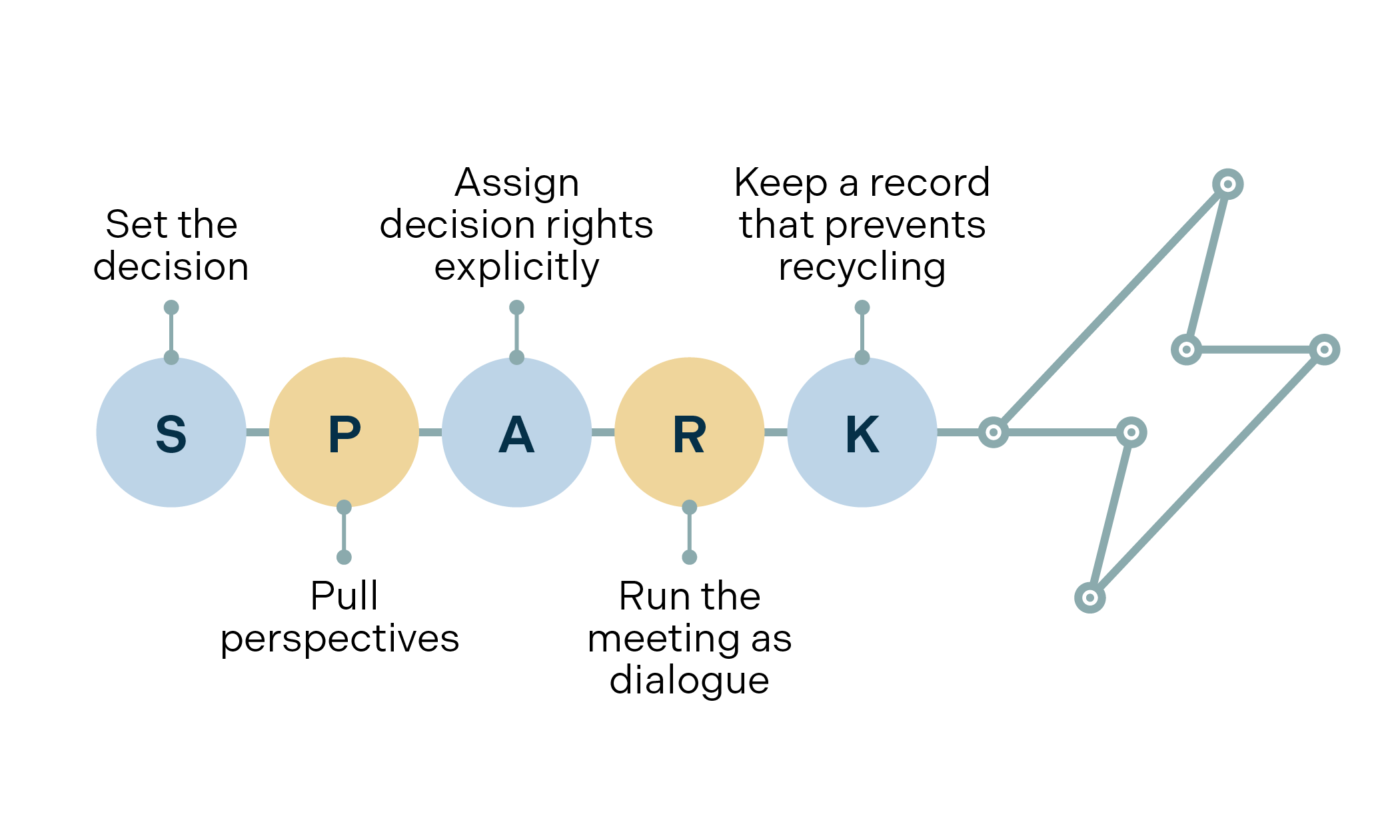
The SPARK model for joint governance
To operationalize joint governance in a way that produces decisions—not noise—use SPARK, a set of design rules for collaborative, accountable forums.
S — Set the decision
If the agenda cannot be written as a clear choice or trade-off, you’re not ready for governance—you’re still brainstorming. Ban vague prompts like “Discuss Digital Strategy.” Use decision language: “Approve AED 18M for platform migration” or “Select vendor A vs. B.”
P — Pull perspectives (not spectators)
Joint governance isn’t “everyone.” It’s the smallest set of perspectives needed to avoid blind spots. In most transformation decisions, four are non-negotiable: Customer, Risk, Delivery, and Finance. Invite expertise, not titles.
A — Assign decision rights explicitly
Define roles before discussion begins. Use a decision-rights method (RAPID works well) and clarify one critical point: who has the D (Decide). Also clarify who does not have veto power. Ambiguous “Agree” roles are where speed goes to die.
R — Run the meeting as dialogue
Kill the presentation. Use pre-reads and enforce “no deck in the room” unless it’s a technical appendix. Time-box debate, and institutionalize dissent: “What would make this fail?” “What is the uncomfortable trade-off here?” Collaboration is not agreement; it’s structured confrontation with reality.
K — Keep a record that prevents recycling
If you don’t log it, you didn’t decide. Capture a one-page decision note: choice, rationale, assumptions, and revisit triggers. This becomes the organization’s memory—and it reduces the tendency to reopen settled questions.
What “good” looks like in practice
When SPARK is working, the behavioral shift is visible:
From escalation to guardrails: teams move faster because authority boundaries are explicit.
From presentation to problem-solving: meetings debate trade-offs, not status updates.
From decision recycling to closure: the same issue doesn’t return every month in a new deck.
From shadow decisions to transparent logs: speed remains, but governance becomes auditable.
How to implement without a reorg
Pilot one forum with high friction (Digital Council, Investment Committee, ExCom).
Create a decision docket: decisions due this month, each with an owner and deadline.
Standardize the one-pager: context, options, recommendation, risks, and required rights.
Introduce rotating chairs to strengthen facilitation and reduce hierarchy dominance.
Run a quarterly governance retro: what stalled, what recycled, what moved—and why.
Risks and trade-offs
The consensus trap: collaboration becomes a veto engine. Mitigation: separate Input from Agree; limit veto to statutory roles (e.g., CFO/Legal).


.svg)