The Middle East Mindshift: Why Strategy Must Speak the Language of Culture
July 17, 2025
8 min read
When a strategy is technically sound but still stalls, the issue is rarely the analysis—it’s the cultural fit. Here is how GCC leaders can design strategies that travel without diluting rigor.
Key takeaways
Treat culture as an operating constraint, not a soft skill. Trust, protocol, and legitimacy are execution requirements. Ignore them and decision cycle time explodes.
Sequence alignment to accelerate delivery. In the Gulf, slower consultation upfront often buys faster execution later.
Translate frameworks, don’t transplant them. Keep the strategic backbone, but re-signal decision rhythm to match local norms of hierarchy and relationship.
Operationalize cultural fluency. Use the MAJLIS model to map influence, design forums, and seal closure in a way that respects tradition while ensuring progress.
Across the GCC, leaders are navigating a convergence: national transformation agendas (e.g., Vision 2030), accelerated digitization of legacy infrastructure, and major generational transitions inside family conglomerates. In this high-velocity environment, strategies rarely fail because the logic is wrong. They fail because they land as foreign—built for one operating system, deployed into another.
A roadmap that earns quick approval in London or New York can lose momentum in Dubai or Riyadh not because stakeholders are “resistant,” but because legitimacy is earned differently. In the Gulf, relationships often precede recommendations, and social permission often precedes scale. If a plan doesn’t earn that permission from the right stakeholders, execution drifts into the quiet freeze of polite meetings and slow throughput.
Share
The Real Problem: Correct Strategy, Wrong Language
The most common failure mode is not open pushback. It’s misfit—a mismatch between what the strategy assumes and how decisions actually get made.
Three patterns show up repeatedly:
The legitimacy gap. A strategy may be formally approved yet remain socially unowned. In many family groups and high-context institutions, legitimacy comes from influencers who may not sit in the steering committee—trusted advisors, non-executive family members, or long-tenured operators.
Protocol misfit. Western playbooks often reward public dissent and rapid confrontation (“disagree and commit”). In high-context Arab environments, public disagreement can create loss of face. Dissent often happens privately; public silence can signal “not yet” (or “no”), not agreement.
Decision ambiguity. When “who decides” is unclear, organizations default to hierarchy. Decisions rise to the Chairman or the elder tier, not because teams lack competence, but because delegation of authority conflicts with cultural deference.
The result is predictable: more coordination, more escalation, more shadow channels—and less delivery.
The Principle: Build for Legitimacy, Not Just Logic
Cultural fluency isn’t a communication layer added at the end; it is execution design at the start.
A practical rule:
If stakeholders must change who they are to execute your plan, the plan won’t scale.
This is not an argument for lowering standards. It is an argument for designing discipline that fits: a culturally aligned pathway for endorsements, decisions, and delivery coalitions—so rigor survives contact with reality.
The Framework: The MAJLIS Model
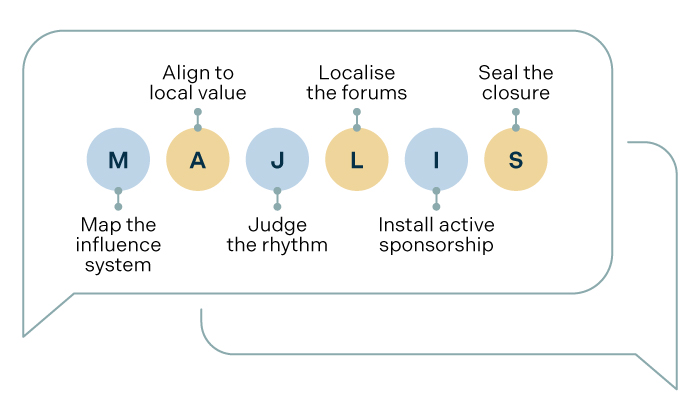
To make strategy locally executable, use MAJLIS—six design moves that convert “best practice” into “right practice.”
To make strategy locally executable, use MAJLIS—six design moves that convert “best practice” into “right practice.”
M — Map the influence system
Don’t confuse the org chart with power. Identify who grants legitimacy, who can stall quietly, and who can accelerate adoption across entities.
A — Align to local value
Go beyond ROI. Link the strategy to what the institution and owners truly protect: reputation, continuity, national contribution, and social legitimacy. In family enterprises, include the logic of legacy.
J — Judge the rhythm
Decide where you need consultation and where you need speed. In the GCC, paying the relationship tax upfront often reduces friction later—because objections surface early and privately, not late and publicly.
L — Localize the forums
Replace generic steering committees with fit-for-purpose decision forums. Ensure the chair has the standing to drive closure. Design agendas that allow relationship-building without letting it consume the decision.
I — Install active sponsorship
Buy-in is passive; sponsorship is active. You need leaders who will defend trade-offs behind closed doors, remove blockers, and carry the narrative across the multi-entity structure.
S — Seal the closure
Prevent decision recycling. Publish a one-page decision note within 24 hours: the choice, rationale, boundaries, and revisit triggers. This bridges oral agreement and auditable governance.
What Good Looks Like
When strategy speaks the language of culture, the behavioral shifts are visible:
From silent delay → structured consultation. Dissent is surfaced through pre-meetings, so the public forum can decide.
From shadow governance → documented closure. Corridor and WhatsApp decisions are translated into formal records.
From escalation by habit → delegation with respect. Decision rights move down without undermining the ownership tier.
From “alignment theatre” → execution coalitions. Stakeholders become carriers of the plan, not reviewers of it.
How to Execute: 5 Steps
Run an Influence Map workshop (90 minutes). Identify the top 10 legitimacy holders and what each one values.
Draft a Local Value Case (one page). Explain why the strategy protects legacy and advances national priorities—not only the P&L.
Convert the steering committee into a Decision Forum. Bring three decisions with options and trade-offs. Ban update decks.
Pre-wire dissent. Hold 15-minute 1:1s with key stakeholders before the main meeting to surface concerns privately.
Publish the Decision Log. Within 24 hours, document the decision, owner, boundary conditions, and next milestone.
Risks and Trade-offs
The consensus trap. Over-indexing on consultation can become paralysis.
Mitigation: Time-box the consultation phase and separate Input from Decide—broad voices, narrow authority.
Tokenism. Asking for input but ignoring it destroys trust faster than not asking at all.
Mitigation: Make changes traceable: “We adjusted X based on Y feedback,” and show what was accepted vs. rejected and why.
Over-localization. In trying to fit culture, teams may dilute governance discipline or create exceptions that erode controls.
Mitigation: Keep the backbone global (risk, audit, thresholds). Localize the route to decisions, not the standards.
Shadow governance relapse. If formal forums feel slow or performative, real decisions will return to WhatsApp and corridors.
Mitigation: Make the formal channel faster than the informal one—decision dockets, pre-reads, and rapid closure notes.
Face-saving creates false agreement. People may nod publicly but block later.
Mitigation: Pre-wire dissent and use explicit closure: “Is anyone not ready to commit?” plus a written decision note with owners.
Leadership Questions
Where is our strategy technically perfect but socially unowned?
Which decisions are stalled because we misread silence as agreement?
Do our forums honor relationship dynamics and produce closure?
Have we satisfied the legitimacy chain required to unlock resources?



.svg)