The Strategic Exit: Mastering Operational Discipline in the GCC Enterprise
March 13, 2025
8 min read
Key takeaways
• Replace “keep going” with “earn the next tranche.” Set explicit evidence thresholds so initiatives must prove value to continue.
• Institutionalize exits, not just launches. Make pivot, sunset, and stop decisions routine—so capacity is freed without drama.
• Turn governance into throughput. A lightweight gating cadence prevents “zombie initiatives” from consuming scarce leadership attention.
• Make stopping safe—and documented. One-page decision notes and closure packs prevent political re-litigation and preserve learning.
In many GCCenterprises, the transformation portfolio is no longer a pipeline—it’s atraffic jam. Ambition is high, experimentation is widespread, and budgets areoften rising. Yet scaling remains stubbornly uneven: in one GCC-focused survey,most organizations reported using AI in at least one function, while only aminority had successfully scaled it enterprise-wide.
This isn’t only anAI problem. It’s a throughput problem—how quickly an organization can convertstrategic intent into outcomes, while retiring work that no longer deservescapacity. In complex GCC environments—multi-entity groups, cross-borderoperations, and reputation sensitivity—the cost of “continuing by default”compounds fast. What quietly breaks performance is not failed projects. It’sprojects that never decisively succeed or stop.
Share
The Real Problem Leaders Underestimate: Continuation Bias
Once an initiative has a sponsor, a budget line, and a steering committee, continuation becomes the path of least resistance. Behavioral research describes this pattern as escalation of commitment—doubling down on a course of action even when evidence weakens, often reinforced by sunk-cost logic, identity, and social dynamics.
In transformation portfolios, continuation bias shows up as:
Pilot purgatory: initiatives keep “learning” but never reach decisions.
Sunk-cost momentum: prior spend becomes the justification for more spend.
Talent lock-in: scarce doers are trapped in underperforming work while higher-value bets starve.
Opportunity cost blindness: boards review milestones, but don’t see what can’t start because capacity is clogged.
If governance forums are designed only to approve and oversee, they will produce more work. If governance is designed to prune and reallocate, it produces speed.
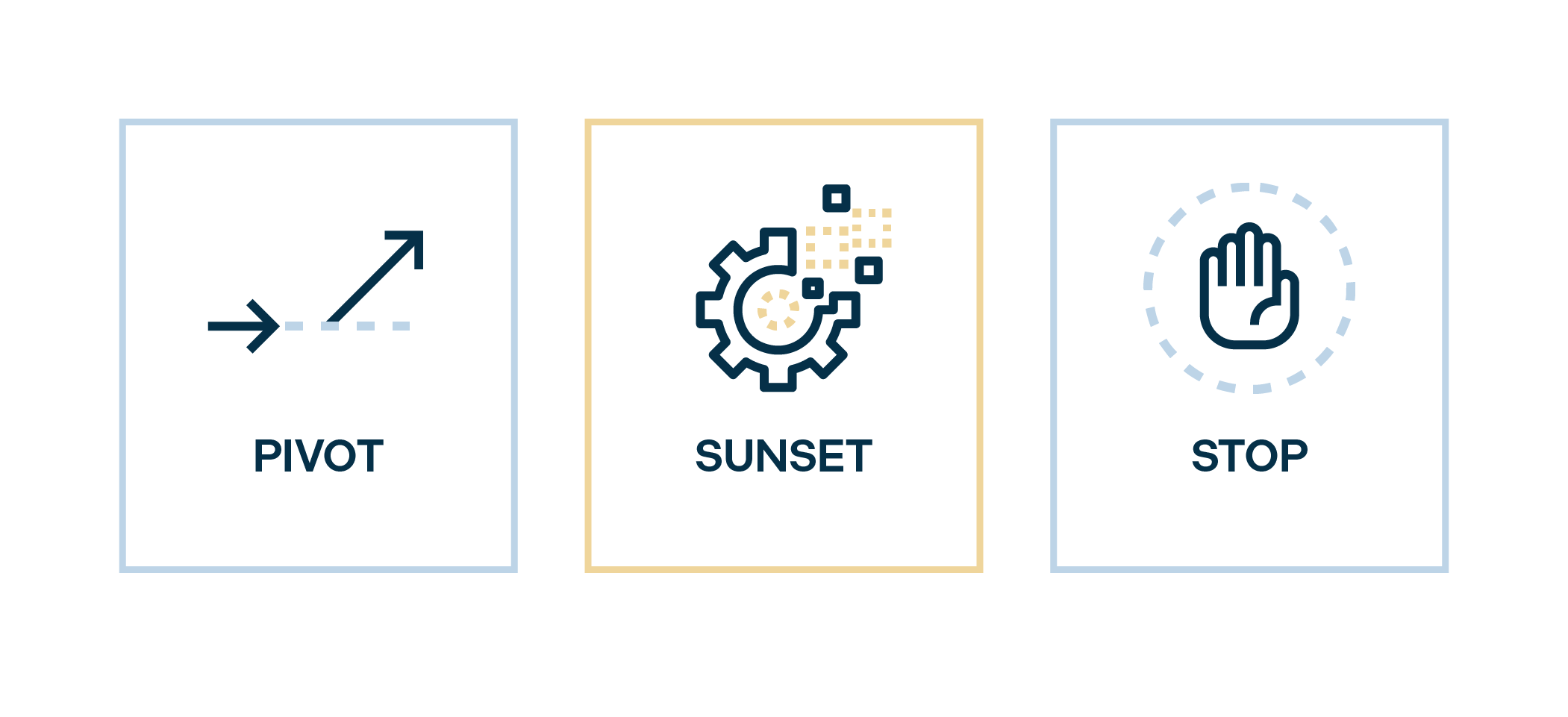
A Practical Model: The PSS Matrix (Pivot–Sunset–Stop)
To keep a portfolio healthy, every underperforming initiative needs an “exit door” that is socially acceptable and operationally clean. The PSS Matrix gives leaders three disciplined moves—based on signals, not narratives:
1) PIVOT — The problem is valid; the approach is wrong.
Redesign scope, simplify the delivery model, or change the mechanism (e.g., from big-bang to staged releases).
Preserve the value hypothesis, change the path.
2) SUNSET — Value is realized; maintenance is now the risk.
Shift from “build” to “run,” with clear ownership and controls.
Capture the workflow, controls, and handover requirements so benefits don’t decay.
3) STOP — The context shifted or evidence is negative.
Terminate funding, archive learning, and reassign talent quickly—before the work goes “off-book.”
McKinsey’s guidance on proactively pruning projects reinforces the logic: organizations often hold on too long, and disciplined mechanisms help leaders decide when to let go.
What Good Looks Like
When “strategic exit” becomes a normal operating discipline, you see observable changes:
From pet projects → portfolio bets: every initiative has explicit exit criteria at kickoff.
From status reporting → signal validation: reviews focus on evidence-to-effort, not dashboard aesthetics.
From stigma → stewardship: stopping is treated as capital discipline, not personal failure.
From delayed reallocation → fast redeploy: talent moves in days, not quarters.
How to Execute: Six Steps to Institutionalize “Scale-or-Kill”
1) Define exit criteria at kickoff • Objective: prevent “success drift.” • Output: pivot/sunset/stop triggers written into the charter.
2) Separate advocacy from decision-making • Objective: reduce sponsor bias. • Output: an independent gate chair for continue/stop forums (a practice aligned with anti-escalation guidance).
3) Run quarterly Scale-or-Kill gates • Objective: make pruning routine, not heroic. • Output: a ranked portfolio view where the bottom slice must justify continuation.
4) Require one-page decision notes for extensions • Objective: make judgment auditable. • Output: decision, evidence, risks, next tranche, and the “kill conditions.”
5) Enforce closure packs for every stop/sunset • Objective: preserve institutional memory and protect realized benefits. • Output: benefit register, lessons learned, ownership handover—aligned with benefits realization practices.
6) Reallocate talent centrally, fast • Objective: convert decisions into throughput. • Output: redeployment within a defined window (e.g., one week), so stopped work truly frees capacity.
Risks and Trade-offs
Fear culture: if exits feel punitive, teams hide bad signals. Mitigate by rewarding clean stops and learning discipline.
Over-pruning: cutting too aggressively can create whiplash. Mitigate by using Pivot before Stop when the problem remains strategic.
Shadow continuations: work persists unofficially. Mitigate by enforcing that only logged initiatives receive funding and capacity.
Leadership Questions
If we reset the budget to zero tomorrow, which three initiatives would we re-fund first—and why?
What percentage of our portfolio is alive because of sponsorship strength rather than evidence strength?
How long does it take for a stop decision to become real capacity in the business?
Do we treat stopping as stewardship—or as embarrassment?
Definitions
Continuation bias: the tendency to keep an initiative going because it already exists, not because it still merits investment.
Zombie initiative: a project that consumes capacity without credible evidence of value.
Scale-or-Kill gate: a recurring decision point where an initiative must earn continuation through signals tied to outcomes.



.svg)