Transformation as an Operating Model: Embedding Change into the GCC Family Enterprise
January 28, 2025
8 min read
Shifting from isolated programs to a model where modernization becomes the default outcome of daily work.
Key takeaways
Stop treating transformation as a department and redesign the day to day operating system so the modern way becomes the default path.
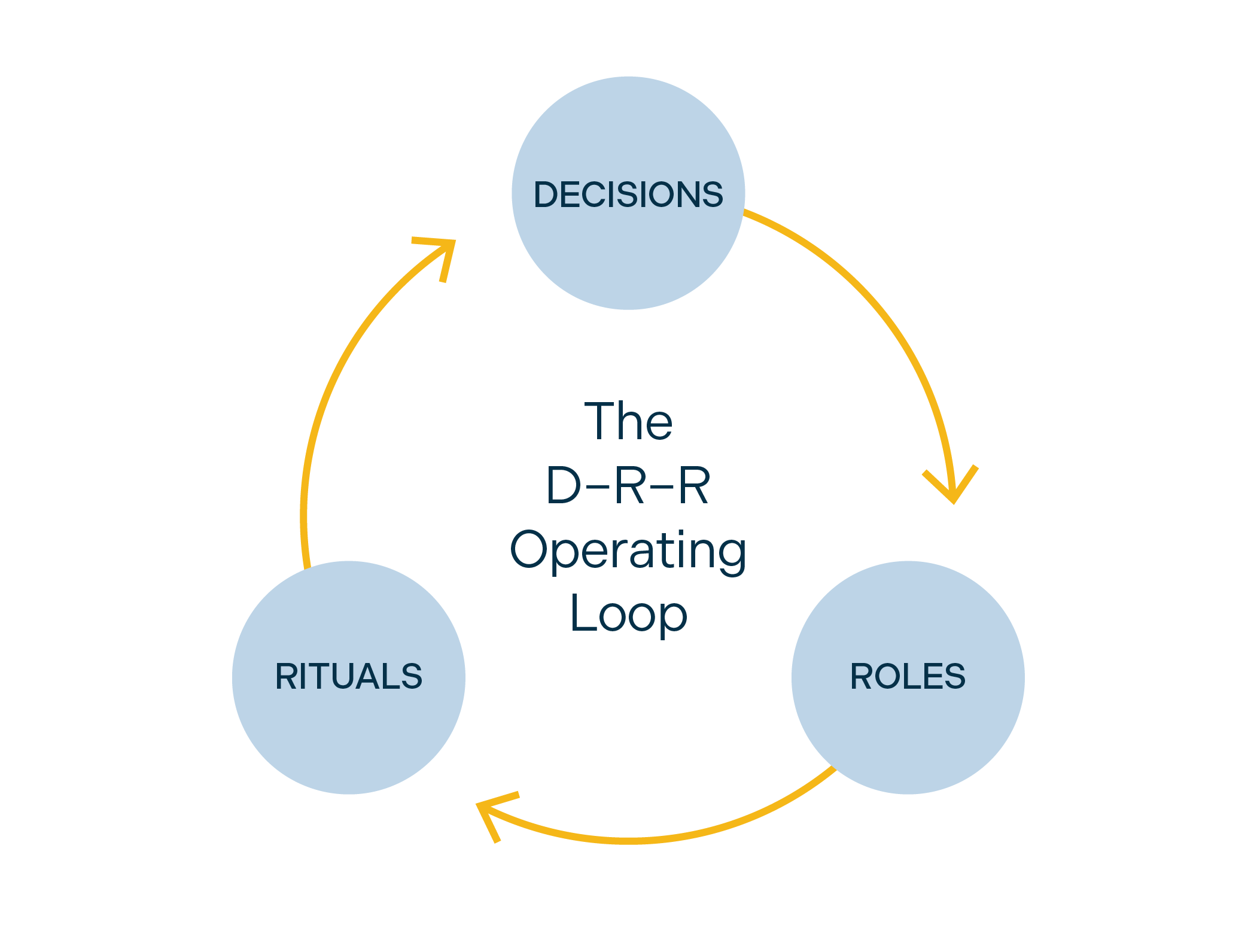
Use the D–R–R loop, Decisions, Roles, Rituals, to embed change into how priorities get set, work gets owned, and learning gets repeated.
Measure learning velocity, not just delivery, by tracking cycle time from idea to test and how much low value work gets retired.
Make Tuesday different on purpose with small rituals, silent pre reads, weekly test slots, stop lists, that turn improvement into habit, not heroics.
If your “Transformation Office” is the busiest team in the company, that is rarely a sign of progress. It is often a sign that change still lives outside the operating system, dependent on special governance, special people, and special energy.
That model does not scale in a GCC family enterprise, where multi entity complexity, stewardship expectations, and tight reputational risk demand something more durable: transformation as an operating model, not a department.
The broader evidence is sobering. HBR research highlights that many transformation programs launch with fanfare but fail to deliver lasting results, only 12 % produce sustained outcomes, a figure that has not meaningfully improved in decades. Bain similarly reports that 88 % of transformations fail to achieve their original ambitions, with overloading top talent and treating transformation as an add on among key failure patterns.
The message is consistent: transformation does not fail because leaders lack intent. It fails because the organization’s daily decisions keep rewarding yesterday.
Share
The real problem: transformation as a “side quest”
Family enterprises often run transformation as a parallel universe: program plans, workstreams, townhalls, dashboards, while Monday to Monday work remains governed by legacy approvals, risk reflexes, and performance metrics optimized for stability, not adaptation.
Three predictable symptoms follow:
Implementation asymmetry Some functions modernize while core operations stay manual, exception driven, and approval heavy.
Dependency on a central team The business outsources change to specialists, local leaders continue to run the real business the old way.
Reversion As soon as the program cadence weakens, the legacy operating model reasserts itself, because it was never redesigned.
Transformation only compounds when it is built into the mechanisms that shape behavior every day.
The D–R–R Operating Loop: Decisions, Roles, Rituals
A practical way to embed transformation is to redesign three levers that determine whether change survives Tuesday afternoons: Decisions, Roles, and Rituals. Think of this as moving from program management to behavioral infrastructure.
1) Decisions: tighten the choice architecture
Transformation is the sum of repeated decisions: what gets funded, what gets prioritized, what gets approved, what gets stopped.
What to change
One-page decision logs for high-frequency decisions (capex, hiring, vendor selection, major policy exceptions). Record: the decision, assumptions, trade-offs, and what would trigger a revisit.
Decision rights claritysochoices don’t bounce between family, board, and management in cycles ofre-litigation
Why it works
Decision logs reduce institutional amnesia and prevent meetings from becoming repeats of last month’s debate. They also protect stewardship: transparency improves trust because the rationale is explicit, not implied.
2) Roles: put improvement into the job
Posters do not change behavior. Job design does.
What to change
Assign explicit ownership for process health, throughput, friction, control effectiveness, not just delivery.
Define an authority band: what teams can simplify or redesign without escalation.
Build a light improvement expectation into roles: one step retired, one process simplified, one experiment shipped per quarter, per team.
Why it works
Bain’s findings on transformation failure emphasize that overloading a small set of star players is a common trap, sustained change requires giving the right people sufficient time and accountability, not stacking transformation on top of everything else.
3) Rituals: upgrade the operating rhythm
Meetings are the organization’s operating system. If they are built for status updates, you will get compliance. If they are built for learning, you will get adaptation.
What to install
A weekly Test Slot: one micro experiment, one learning, one next action.
A weekly Stop List: what gets retired to free capacity, the fastest way to fund change is to stop low value work.
A pre decision 90 second silent review to raise signal over opinion and reduce premature convergence.
Why it works
HBR’s transformation research underscores that lasting results come from changing how work runs day to day, not simply launching another initiative. Rituals convert intent into repeatability.
What good looks like
In embedded transformation, you see the shift in observable behavior:
Decisions are made with explicit assumptions, not implied preferences.
Teams can run a 14 day test without navigating a pilgrimage of approvals.
Leaders measure learning velocity alongside delivery: cycle time from idea to test, steps retired, rework avoided.
The central transformation team becomes smaller and more strategic, because execution ownership lives in the business.
The outcome is not constant change. It is continuous modernization at a sustainable cadence.
Five steps to make Tuesday different
Map value flow, not org charts: where do approvals, handoffs, and rework accumulate?
Standardize decision logs for the top 10 recurring leadership decisions.
Define authority bands by risk tier, what teams can change independently vs. what requires escalation.
Install two rituals: Test Slot + Stop List, then protect them from urgent noise.
Add two learning metrics to monthly reviews: cycle time to test, and steps retired.
Risks and trade offs
Autonomy without guardrails creates fragmentation, authority bands must be explicit.
Ritual fatigue happens if rituals are performative, tie each ritual to a visible outcome, capacity freed, risk reduced, cycle time improved.
Speed vs. quality tension is real, tighter decision design may slow the first decision but accelerates execution by reducing rework.
Leadership questions
Which daily processes quietly reward legacy behavior while we talk about change?
What work should we stop to create capacity for improvement?
Where do we repeatedly re litigate decisions because assumptions were never documented?
If we removed 30% of approval steps, what risks would actually increase, and which are just inherited habits?



.svg)