Beyond the Pilot: Why Proven AI Doesn't Spread, and How to Make Every Deployment Cheaper Than the Last
December 3, 2025
8 min read
Most organizations have already proven that AI works. The unsolved problem is making the next deployment easier than the one before, so value finally compounds instead of restarting.
Key takeaways
Scaling AI is a repeatability problem, not a technology problem. The model is rarely the constraint; the rebuilding is.
The hidden cost is the rebuild tax: every new use case re-creating the data, governance, and integration the last one already paid for.
Standardized foundations, reusable patterns, and clear business ownership are what let a proven pilot travel. Without them, each deployment starts from zero.
Measure replication, not novelty. Success is fewer pilots reaching production faster, not more demos.
Across industries and across the GCC, AI pilots are everywhere. Customer-service assistants, forecasting models, document drafting, automated reporting. The demonstrations impress, the business cases get approved, and then, for most organizations, very little changes. Months later the conversation is still about AI's potential rather than its value. The issue is not whether the technology works. It is whether the organization can make it work repeatedly.
The evidence is blunt. MIT's 2025 study of enterprise AI found that 95% of generative-AI pilots delivered no measurable impact on the P&L, and only about 5% reached production with significant value. Strikingly, the report concluded that the barrier was rarely model quality. It was integration: tools that shine in a demo but do not connect to real workflows, data, and accountability. The same study found that large enterprises took around nine months to move a pilot into production, while mid-market firms did it in roughly ninety days. The difference was not the AI. It was the machinery for putting it to work.
Share
The real problem leaders underestimate: the rebuild tax
This is not a question of whether to fund or stop a given pilot, which is a separate discipline. It is the question of why a use case that demonstrably works in one corner of the business never spreads to the next. The usual answer is that each deployment is treated as a one-off. Every new use case re-creates the data pipelines, the governance, the human-in-the-loop rules, the integration, and the change management from scratch. The result is a cost worth naming: the rebuild tax, the price an organization pays when nothing it learns or builds in one deployment is reusable in the next.
The rebuild tax shows up in four ways. Ownership ambiguity leaves no one accountable once a pilot moves from the lab toward operations. Workflow resistance appears when AI is dropped into a process that was never redesigned to receive it. Scaling friction means every new use case rebuilds governance, data, and approvals as if for the first time. And adoption gaps emerge when people understand the tool but never fold it into their daily work. Each one is survivable in a single pilot. Together they guarantee that the organization accumulates pilots and almost no production.
A better lens: scale is a system, not a sequence of projects
High-performing organizations stop asking "can this AI solution work?" and start asking a more demanding question: "how do we make every successful AI solution easier to deploy than the last?" That shift turns AI from a series of heroic, hand-built projects into an organizational capability. The aim is a reusable chassis, common foundations and patterns that a new use case can plug into, so the marginal cost of the next deployment falls each time rather than resetting to full price. MIT's data points the same way: the firms that crossed the divide were not the ones with the cleverest models, but the ones that paired tight scope with disciplined integration, often blending internal teams with external expertise.
The SCALE framework
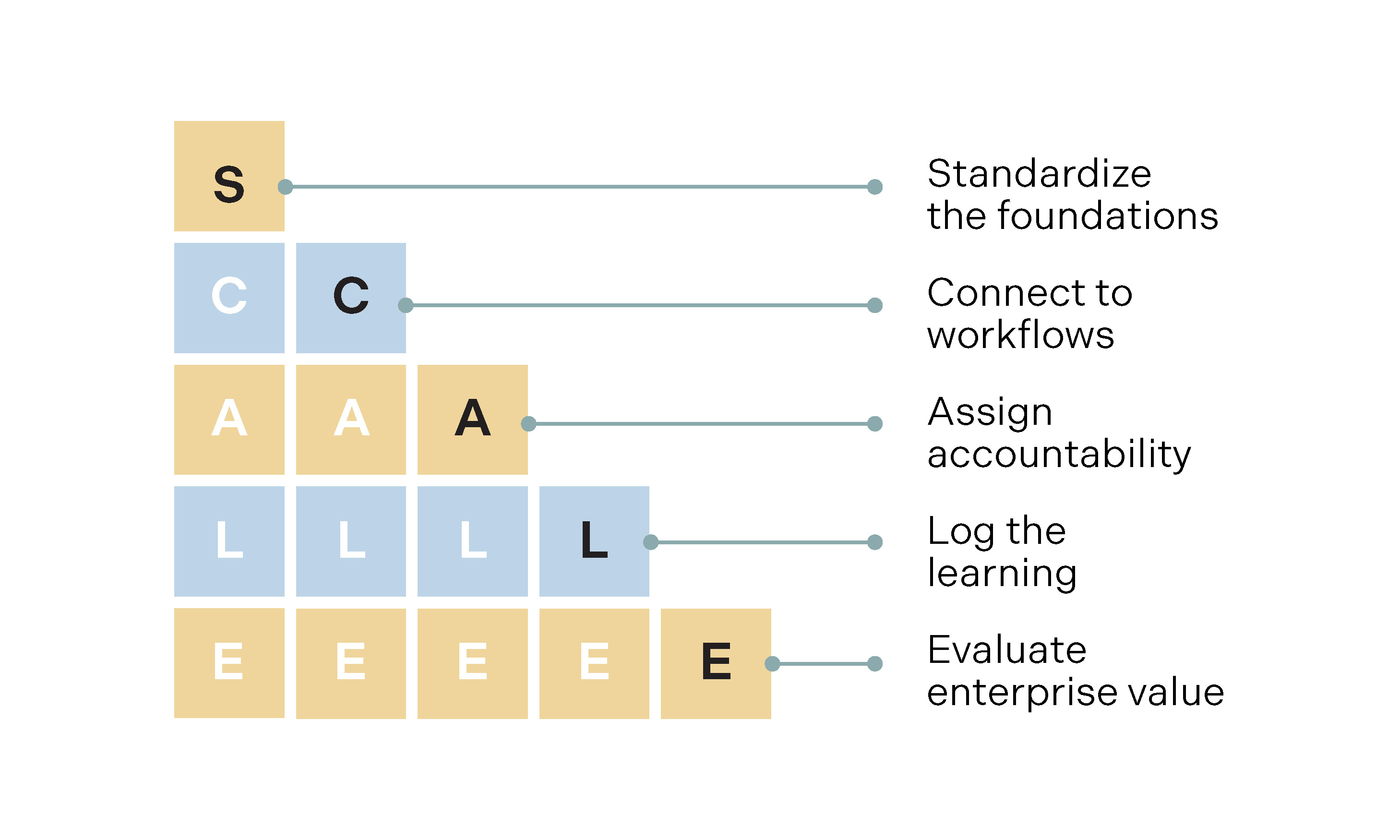
To convert proven pilots into compounding value, leaders can apply SCALE.
S, Standardize the foundations
Build common, reusable assets once: data definitions, governance controls, prompt and template libraries, model-review processes, and approval pathways. The single biggest source of the rebuild tax is teams re-creating the same scaffolding for every use case.
C, Connect to workflows
Insert AI into how work already moves rather than bolting it on as an extra task. Adoption follows integration, which means redesigning the surrounding process so the tool removes steps instead of adding a new screen.
A, Assign accountability
Give every AI-enabled process a named business owner. Technology teams enable and assure; the business owns the outcome. Replication stalls fastest where ownership is left with "the AI team.
L, Log the learning
Capture what worked, what failed, what should be reused, and what should be avoided after each deployment, so the next team inherits a pattern rather than a blank page. This is how an organization turns experience into a falling cost curve.
E, Evaluate enterprise value
Move past pilot metrics to business outcomes: adoption, cycle-time reduction, throughput, rework, and cost-to-maintain against value delivered. Scale is proven in operations, not in the demo.
What good looks like
Organizations that beat the rebuild tax show clear shifts. AI projects give way to AI capabilities. Experimentation gives way to repeatability. Isolated wins give way to enterprise adoption. Technology ownership gives way to business ownership. And the innovation lab gives way to operational value. The tell is simple: the organization is running fewer pilots and putting more of them into production, faster than it did last quarter.
How to execute: five moves in the next 90 days
Pick one use case that has already proven measurable value and treat it as the seed for replication, not a trophy. Build a reusable pattern library that documents its prompts, governance controls, workflow design, approval steps, and lessons, so the next team starts from it rather than from nothing. Assign clear business ownership for adoption and outcomes. Replicate the proven case into two adjacent teams or units, and track how much cheaper and faster the second and third deployments are than the first. And stand up an AI value dashboard that tracks adoption, productivity gains, cycle-time improvement, and retired work, so replication is measured rather than assumed.
Risks and trade-offs
The first risk is innovation addiction, where the organization keeps launching new pilots instead of scaling proven ones; reallocate resources toward replication. The second is governance overload, where universal controls smother deployment; apply risk-based governance, heavier on high-stakes use cases and lighter elsewhere. The third is technology-led scaling, where IT drives adoption without a business owner; assign accountability to operational leaders. The fourth is the capability gap, where people receive tools but not support; pair every deployment with role-based enablement.
Leadership questions
Which of our AI pilots have proven value but remain stuck in one corner of the business?
What exactly do we rebuild from scratch every time we deploy a new use case?
Are we investing more in experimentation or in replication?
Who owns the outcome once a pilot ends?
If we stopped launching new pilots tomorrow, how much value could we unlock from what already works?
The organizations that create the most value from AI will not be the ones with the most advanced models. They will be the ones that build the best machinery for scale, so that proving an idea once means it can be deployed everywhere it matters at a fraction of the original effort. The future of enterprise AI is not another impressive demonstration. It is making the second, third, and tenth deployment cheaper, faster, and more reliable than the first.
Share
References
MIT NANDA initiative. The GenAI Divide: State of AI in Business 2025. Based on 150+ leader interviews, surveys, and analysis of 300 public AI deployments: roughly 95% of enterprise generative-AI pilots delivered no measurable P&L impact; only about 5% reached production with significant value; the funnel runs from 80% exploring to 60% evaluating, 20% piloting, and 5% in production; large enterprises took around nine months to scale versus ninety days for mid-market firms; the primary barrier was integration and workflow rather than model quality.
MIT NANDA (2025). Deployments blending internal specialists with external expertise reached far higher success rates than IT-only builds, and more than half of AI budgets went to high-visibility, low-return use cases rather than higher-ROI back-office processes.


.jpg)
.svg)


.jpg)
.jpg)
.jpg)


