Beyond the Spreadsheet: Why Foresight Beats Data in a World That Measures Everything
October 23, 2025
8 min read
Every dataset describes a world that has already happened. Advantage now belongs to the organizations that can see what the numbers cannot yet show.
Key takeaways
Data is retrospective by design. It explains the past well and the future poorly, so an organization built around dashboards becomes expert at hindsight and blind to what is coming.
The scarce capability is anticipation. Competitive advantage increasingly comes from spotting weak signals early and acting before a pattern is obvious to everyone.
Foresight is a discipline, not a gift. It combines evidence, imagination, and judgment, and it can be built into the operating rhythm.
Insight is the bridge. It is how an organization turns what the data records about yesterday into a defensible view of tomorrow.
Most leadership reporting answers a single question with great precision: what happened? Dashboards update in real time, indicators arrive instantly, and forecasting models grow more sophisticated each year. Yet many leadership teams face a quiet paradox. They know more than ever, but they do not see further than ever. Their instruments are pointed firmly at the past.
This matters more in the GCC than almost anywhere. The pace of change in the region, driven by national diversification agendas, rapid digitization, and the arrival of AI as a default tool, means the future routinely refuses to resemble the recent past. In that environment, an organization that can only explain its last quarter is already behind. The questions that create advantage are different ones. What are we not seeing? Which faint signal will matter most? What opportunity is forming beneath the numbers, before it shows up in them?
Share
The real problem leaders underestimate: the foresight gap
Most organizations assume better decisions come from better information, and they respond predictably: more dashboards, more reports, more models. Yet as information grows, the ability to anticipate often shrinks. The distance between how much an enterprise measures and how little it anticipates is worth naming directly: the foresight gap.
It shows up in four ways. The first is hindsight saturation, where leadership time is consumed reviewing performance and explaining variances, with almost none left for what lies ahead. The second is pattern blindness, where trends are visible on the chart but their implications go unread. The third is anticipation atrophy, where the organization has simply lost the habit of asking what is coming next, because nothing in its cadence rewards the question. The fourth is imagination deficit, where teams become excellent at describing the present and unable to picture a plausible alternative future. The result is a costly inversion: leaders spend ever more time discussing data and ever less time discussing possibility.
The stakes are not hypothetical. A landmark longitudinal study of corporate foresight found that "future-prepared" firms, those that systematically scan for and act on early signals, outperformed the average by 33% in profitability and by 200% in market-capitalization growth, while firms with foresight deficiencies carried a marked performance discount. The Boston Consulting Group's 2026 analysis of 500 organizations pointed the same way, noting that boardroom discussion of uncertainty spiked sharply through 2025. The gap between measuring the world and anticipating it has become a measurable disadvantage.
A better lens: data describes, insight decides, foresight prepares
Data has a real and serious role, but a bounded one. It can tell leaders what happened and often why. It rarely reveals what should happen next. That leap requires three ingredients working together. Evidence explains reality, imagination explores possibility, and judgment selects direction. Remove any one and quality collapses: evidence without imagination produces optimization of the wrong thing, imagination without evidence produces speculation, and judgment without either produces guesswork. The objective is not better reporting. It is better sense-making aimed at the future rather than the past.
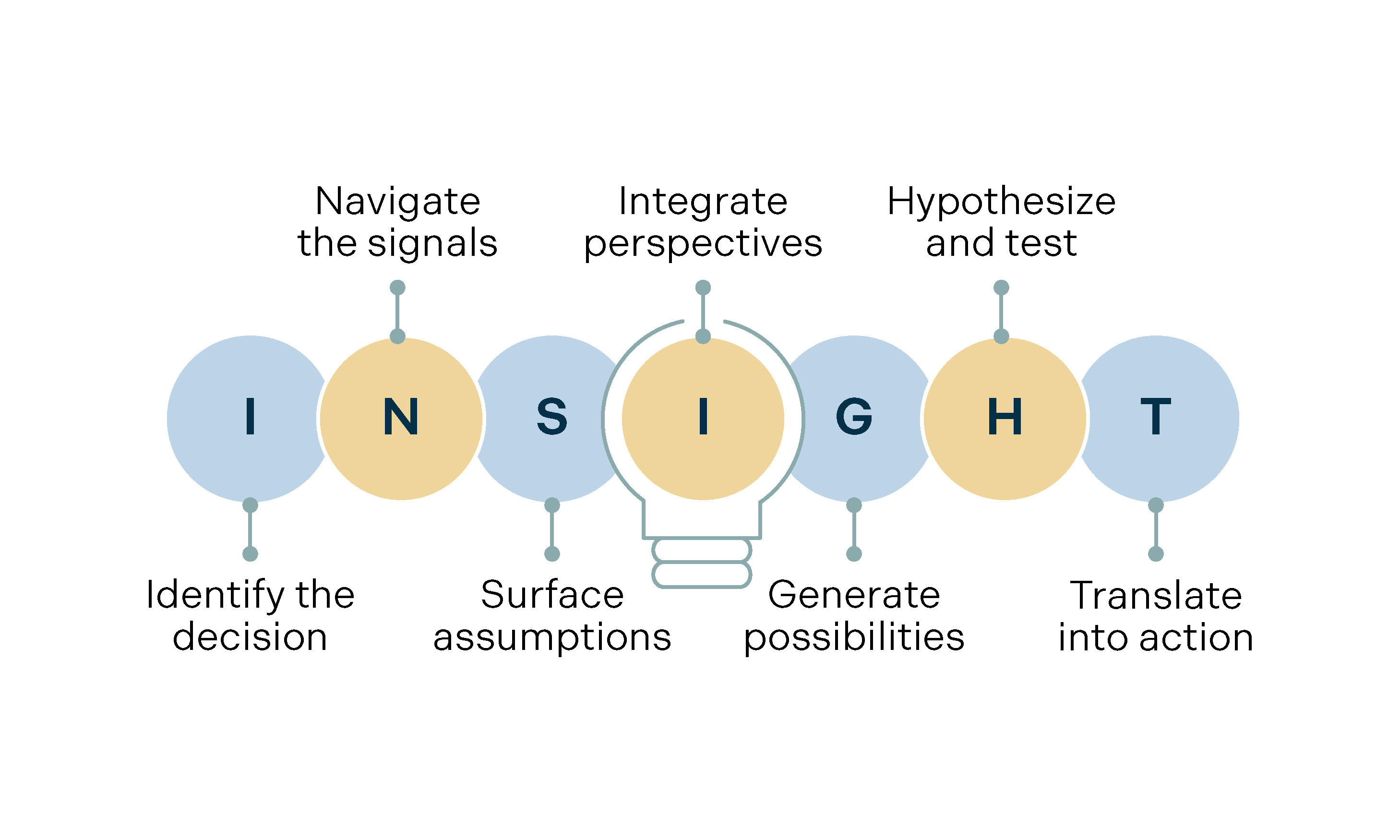
The INSIGHT framework
To turn retrospective data into forward advantage, leaders can apply INSIGHT.
I, Identify the decision
Start with the bet that has to be made, not the data that happens to exist. Naming the future choice gives the analysis a target and keeps it from collapsing into description.
N, Navigate the signals
Look past the headline metrics for the weak signals at the edges, the early indicators of change that rarely appear in the standard report. The aim is sharper attention, not more of it.
S, Surface assumptions
Every strategy rests on a view of the future. Make it explicit, then ask what has changed and what could invalidate it. Most organizations are undone less by bad data than by assumptions that quietly expired.
I, Integrate perspectives.
The most useful foresight comes from the intersection of disciplines and from the outside in. Combine the view from customers, operations, finance, technology, and the frontline, where change is usually felt before it is counted.
G, Generate possibilities.
Move deliberately from pattern to implication. Develop a small set of plausible alternative futures and ask what each would demand, so the organization is rehearsed rather than surprised
H, Hypothesize and test
Convert a promising signal into a small, time-boxed bet with a clear way to learn from it, rather than debating it indefinitely. Foresight earns its keep through cheap experiments, not certainty.
T, Translate into action
A signal that changes no decision, experiment, resource allocation, or strategic stance is an observation, not an advantage. Insist that foresight ends in a move.
What good looks like
Organizations that close the foresight gap show recognizable shifts. Dashboards become decision instruments rather than rear-view mirrors. Reporting gives way to sense-making. Analysis paralysis gives way to disciplined experimentation. Metric reviews give way to opportunity discovery. And backward-looking discussion gives way to forward-looking decisions. Leaders spend less time explaining what happened and more time shaping what happens next.
How to execute: five moves in the next 30 days
Audit your leadership forums and identify the meetings dominated by reporting rather than decision or anticipation. Retire the dashboard metrics that no longer change any choice, so attention is freed for signals that matter. Convert one recurring reporting session into a monthly foresight review built around weak signals and alternative futures. Launch a hypothesis sprint that turns a promising signal into a small, testable bet. And measure learning velocity, the time between spotting a signal, acting on it, and seeing the outcome, so foresight becomes a tracked capability rather than an occasional luxury.
Risks and trade-offs
The first risk is analysis addiction, delaying decisions in search of perfect information; set evidence thresholds and decision deadlines. The second is creativity without discipline, where possibilities multiply but never get validated; require every scenario to carry a hypothesis and a test. The third is confirmation bias, where foresight is used to defend existing beliefs; institutionalize assumption reviews and disconfirming searches. The fourth is metric inflation, where new reports pile on top of old ones; enforce a strict one-in, one-out rule on reporting.
Leadership questions
Which decisions stall because we keep asking for more data instead of forming a view?
What opportunity might already be visible in the signals we are not reading?
Are our dashboards helping us decide, or helping us avoid deciding?
Where do we need more imagination rather than more analysis?
If we cut our reporting in half, would our anticipation improve or decline?
The organizations that win in a world saturated with measurement will not be the ones that collect the most data. They will be the ones that turn it into foresight, and act on what they see before their competitors can. Advantage rarely comes from what is measured. It comes from what is understood about the future, and from the courage to move on it first.
Share
References
Boston Consulting Group / Harvard Business Review (January 2026). What Companies that Excel at Strategic Foresight Do Differently. Survey of 500 organizations; firms with more advanced foresight outperform peers; sharp 2025 rise in executive discussion of uncertainty.
René Rohrbeck and Menes Etingue Kum (2018), Corporate Foresight and its Impact on Firm Performance: A Longitudinal Analysis, Technological Forecasting & Social Change, vol. 129, pp. 105–116. "Future-prepared" (vigilant) firms outperformed the average by 33% in profitability and 200% in market-capitalization growth; firms with foresight deficiencies faced a performance discount of 37% to 108%.


.svg)