The Leadership Loop: Building Public-Sector Excellence That Outlasts Its Leaders
October 14, 2025
8 min read
The highest-performing government entities do not depend on extraordinary leaders. They build systems that keep producing extraordinary outcomes after those leaders move on.
Key takeaways
Treat excellence as an operating capability, not a leadership trait. Sustainable performance comes from a system, not from heroics.
The real failure is not weak performance. It is performance that does not compound, so each leadership change restarts the climb from the bottom.
Build a loop that converts evidence and learning into better decisions and services on a permanent cadence, rather than launching another improvement program.
Measure resilience, not just results. The test of excellence is whether it survives a transition and keeps improving afterward.
Across the GCC, public-sector organizations are being asked to deliver more than ever. National transformation agendas, rising citizen expectations, digital modernization, and tighter fiscal discipline are converging on government institutions at the same time. Most respond by investing in strategy, technology, talent, and governance reform. Yet performance stays uneven. Some entities accelerate and compound their gains; others post strong results for a year or two and then stall. The difference is rarely the quality of the vision. It is the operating system underneath it.
The strongest institutions do not simply execute initiatives well. They create conditions in which excellence reinforces itself, so the organization gets better even as the people at the top change.
Share
The real problem leaders underestimate: excellence that does not compound
Most public organizations assume performance rises when leadership improves. There is truth in that, but it hides a deeper risk. When results depend on a small group of exceptional individuals, excellence becomes fragile, and a single transition, reorganization, or shift in political priority can undo years of progress. The organization keeps running, but it stops getting better. Every new leadership team inherits effort rather than capability and starts the climb again.
This is the quiet failure mode of public-sector reform: gains that never become institutional. They stay in a few leaders' heads instead of the system's routines. They live inside time-bound projects that end when the funding does. They rest on personal relationships rather than durable processes. And they are never connected to evidence, so the organization cannot tell which improvements actually worked or repeat them deliberately. The result is performance that is episodic rather than self-sustaining, however impressive any single year looks.
The cost shows up where it matters most, in public trust. The OECD's Government at a Glance 2025 found that fewer than four in ten people across member countries trust their national government, and only around four in ten believe their government makes decisions based on the best available evidence. Trust is earned by consistency over time, and consistency is exactly what non-compounding excellence cannot deliver.
A better lens: excellence is a loop, not an achievement
High-performing institutions treat excellence as a continuous cycle rather than a destination. The goal is not strong results this year. It is a system that reliably produces strong results next year, under different leaders, against different challenges. That requires connecting strategy, evidence, technology, and learning into a reinforcing cycle: a loop that turns each round of delivery into sharper decisions in the next. Not a project, not a program, but a permanent capability built into how the organization runs.
The LOOP framework
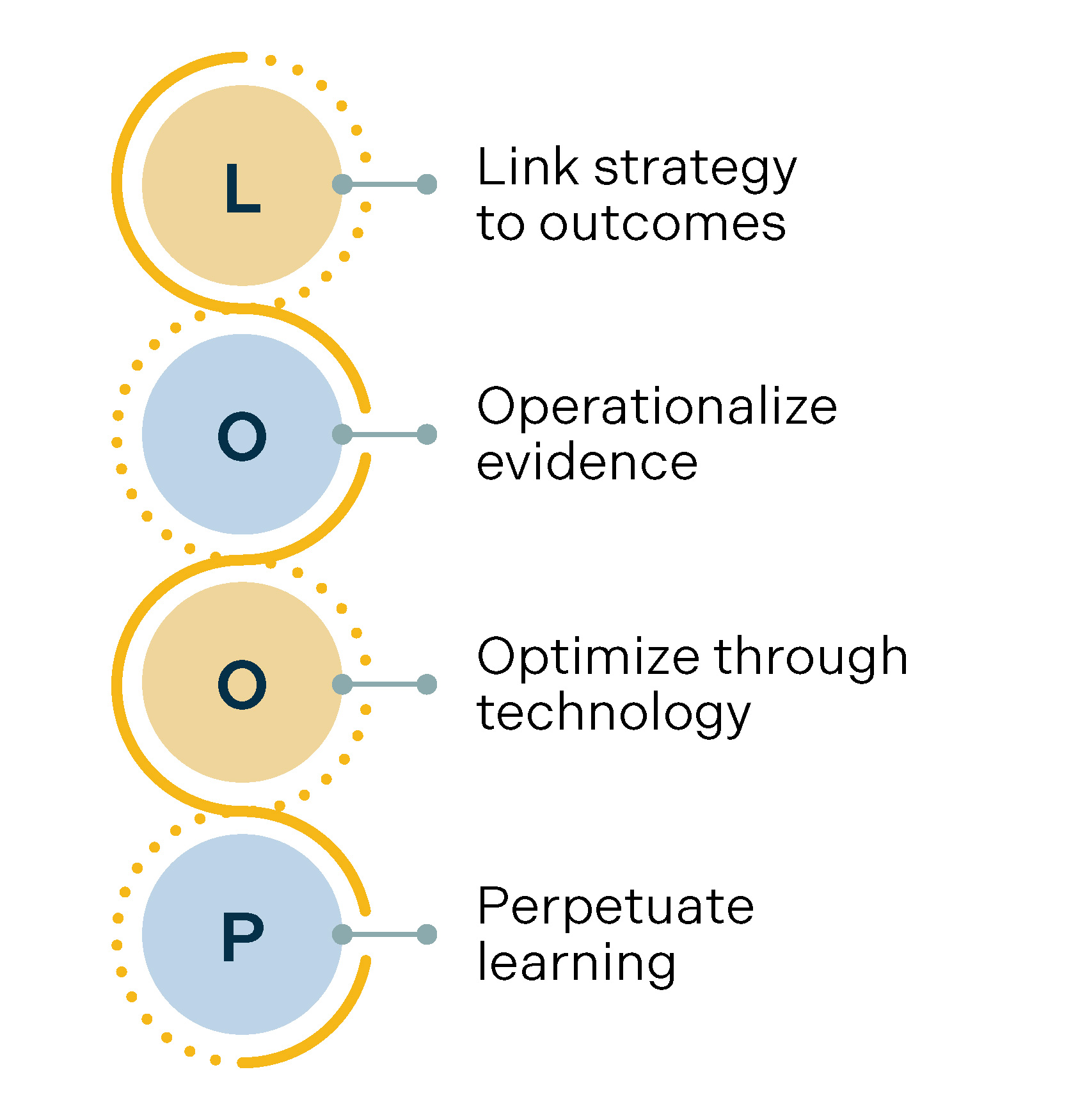
A practical way to create self-sustaining excellence is LOOP.
L, Link strategy to outcomes
Connect every initiative, program, and service directly to a strategic priority and a citizen outcome. Momentum leaks when strategy drifts from operational reality and teams can no longer see how their work changes anything for the public it serves.
O, Operationalize evidence
Ground decisions in data, performance indicators, and citizen feedback rather than hierarchy and habit. When only four in ten citizens believe government decides on the best available evidence, building a visible evidence base is not a technical nicety; it is how an institution earns the right to be trusted with discretion.
O, Optimize through technology
Use digital tools to improve how work moves, not merely how information is stored. The OECD's Digital Government Index, at 0.61 on a 0-to-1 scale, shows how much headroom remains. The aim is throughput, transparency, and citizen value, which means redesigning the workflow before automating it.
P, Perpetuate learning
Install structured learning into the operating rhythm: what worked, what failed, what should scale, and what should stop. Improvement becomes a standing routine rather than a periodic campaign, and that is the mechanism by which gains finally compound instead of resetting
What good looks like
When the loop is working, the behavioral shift is visible. Leadership dependence gives way to institutional capability. Isolated projects give way to continuous improvement. Compliance reporting gives way to performance learning. Departmental silos give way to enterprise collaboration. And the organization moves from reacting to challenges toward anticipating them.
A useful test: if the entire leadership team turned over tomorrow, would the organization keep getting better, or merely keep running? The answer reveals whether excellence has been institutionalized or simply personalized.
How to execute: five moves in the next 90 days
Start with a dependency assessment that identifies where decisions, knowledge, relationships, and improvement efforts rest on specific individuals, and treat the map as a resilience risk. Build outcome pathways that connect strategic objectives to operational activities and citizen results, so every team can trace its line to public value. Launch evidence forums, structured decision meetings focused on performance signals and policy outcomes rather than status updates. Establish cross-agency improvement teams around shared priorities to break silos where citizens actually experience them. And install a loop dashboard that tracks performance, learning, collaboration, and capability development together, so resilience is governed, not assumed.
Risks and trade-offs
The first risk is technology without process redesign, where digital tools simply automate existing inefficiencies; redesign the workflow before digitizing it. The second is reporting overload, where organizations gather far more data than they can act on; the discipline is to keep only decision-grade measures tied to outcomes. The third is improvement fatigue, where too many initiatives dilute attention; the answer is a small portfolio of high-impact improvements rather than a long wish list. The fourth is leadership relapse, the slow return to personality-driven management, which only embedded governance, learning, and accountability routines can prevent.
Leadership questions
Which parts of our performance still depend on specific individuals rather than the system?
Where are we treating excellence as an event instead of a cycle?
Are our decisions driven by evidence, or by hierarchy and habit?
What learning mechanisms exist beyond the annual review and the audit?
If our leadership changed tomorrow, would the organization keep improving?
Public-sector excellence is not built through isolated successes. It is built through systems that learn, adapt, and improve on a permanent cadence, so that progress accumulates rather than restarts. The strongest institutions do not rely on exceptional leaders to carry them. They build environments where the next generation of leaders inherits capability, not just expectation, and where excellence has become the default rather than the exception.
Share
References
OECD. Government at a Glance 2025. Fewer than four in ten people (39%) across OECD countries trust their national government; roughly four in ten believe government decides on the best available evidence; OECD Digital Government Index averages 0.61 on a 0-to-1 scale.
OECD. Survey on Drivers of Trust in Public Institutions, 2024 Results. Identifies responsiveness, reliability, integrity, openness, and fairness as the core drivers of public trust.



.svg)