Reimagining Change Management: Why Resistance Is Information, Not Opposition
September 22, 2025
8 min read
The biggest obstacle to transformation is not resistance. It is designing change without listening to what the resistance is trying to tell you.
Key takeaways
Stop treating resistance as a people problem. Most of it is operational intelligence about friction, unclear expectations, and misaligned incentives.
Design change around impact, not announcements. People support change when they understand how it changes their decisions, their workload, and their definition of success.
Co-create rather than broadcast. Participation produces ownership faster than persuasion ever will.
Read the signal before managing the symptom. Resistance points to exactly where the change design is weak.
Across the GCC, transformation has become a permanent condition. Digital modernization, AI adoption, organizational redesign, regulatory change, and national development agendas are reshaping how organizations operate at remarkable speed. Yet a familiar pattern keeps repeating. The strategy is approved, the roadmap is published, the launch event generates real energy, and then progress slows. Deadlines slip, adoption weakens, and leaders conclude that employees are simply resistant to change.
Resistance is rarely the root problem. Most transformations struggle because organizations read resistance as opposition when it is closer to information. When people push back, they are often signaling something useful: uncertainty, a capability or workload gap, a competing priority, unclear ownership, or a lack of trust in how the change will actually unfold. The organizations that transform well do not eliminate resistance. They learn from it.
That this is hard is not surprising. Gartner research, reported in Harvard Business Review, found that employee willingness to support enterprise change fell from 74% in 2016 to 43% in 2022, even as the average employee faced about ten planned changes a year, up from two. Resistance, in that context, is not irrational defiance. It is a predictable response to relentless change, and it carries a message worth decoding.
Share
The real problem leaders underestimate: change friction
Most organizations diagnose transformation trouble as a communication problem and respond predictably: more town halls, more newsletters, more leadership messaging. Yet people usually understand the change perfectly well. What they do not understand is how they are supposed to succeed inside it. That gap, between strategic intent and individual reality, is worth naming: change friction.
It tends to take four forms. Meaning friction appears when employees grasp what is changing but not why it matters to them. Capability friction appears when new expectations arrive ahead of the skills and support to meet them. Workload friction appears when new activities are added while none of the old work is taken away. And trust friction appears when people quietly doubt that leadership will hold the course once the effort gets difficult. As friction accumulates, resistance becomes visible. The common mistake is to treat the visible symptom rather than remove the source.
A better lens: resistance is a diagnostic signal
High-performing organizations treat resistance as data rather than disobedience. When frontline employees challenge a new process, they may be exposing a genuine flaw in its design. When managers stall on adoption, they may be revealing ambiguity in decision rights. When teams build workarounds, they are usually showing exactly where a capability or system constraint sits. None of that is noise to be suppressed. It is feedback that, taken seriously, makes the change better. The objective is not to win agreement. It is to convert resistance into a sharper, more workable design.
The SHIFT framework
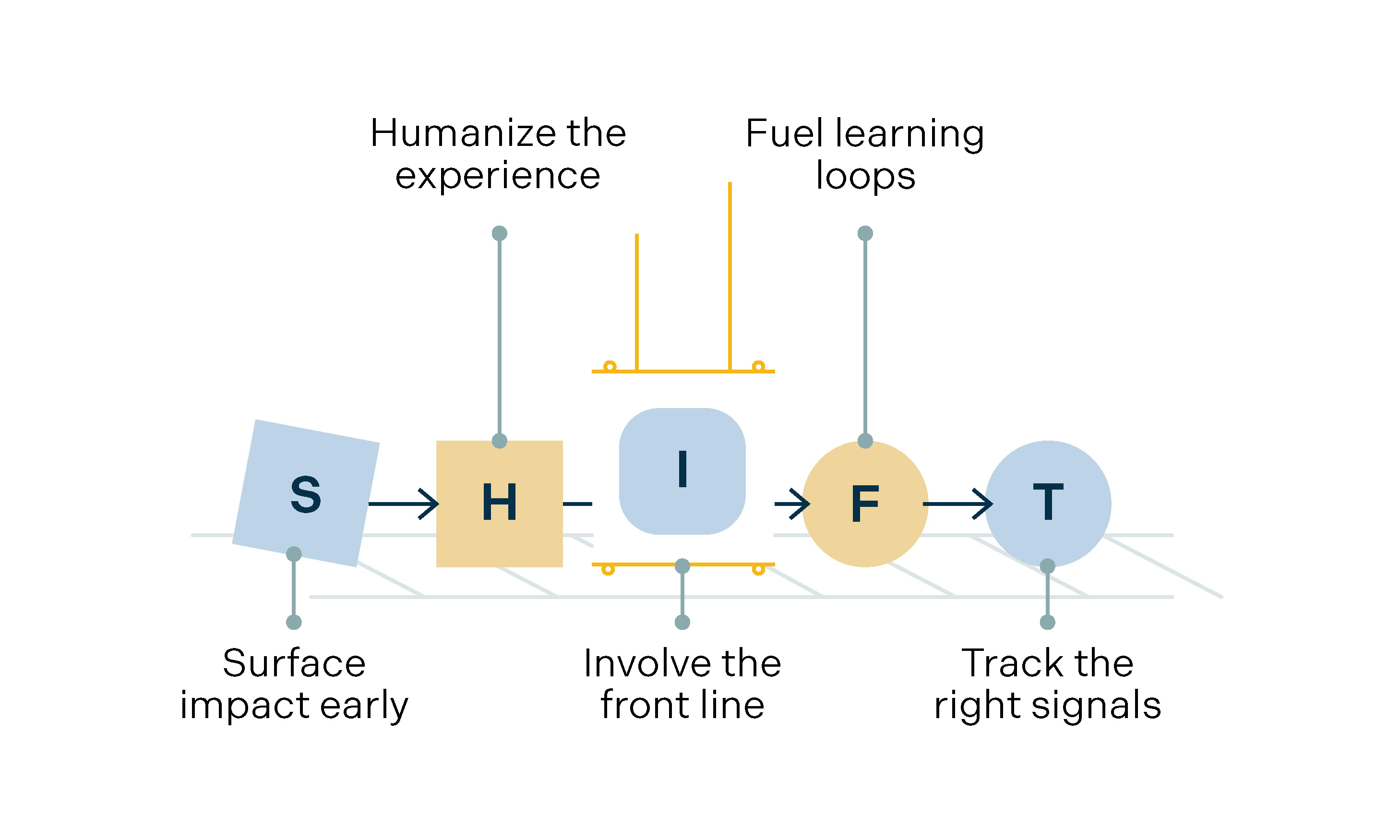
A practical way to put that into practice is SHIFT.
S, Surface impact early.
Before announcing a change, map how it lands for each group: their decisions, workload, authority, performance expectations, and daily routines. People rarely resist strategy in the abstract. They resist uncertainty about their own role inside it, so resolve that uncertainty first.
H, Humanize the experience.
Treat empathy as an operating mechanism, not a communication tactic. Say plainly what will get easier, what will get harder, and what work will stop. Naming the trade-offs honestly builds more credibility than promising that everything improves.
I, Involve the front line.
Bring the people closest to the work into the design through short co-creation sprints, where they identify friction, test improvements, and shape implementation. Participation turns observers into owners, and Gartner's own research finds that involving employees in change planning materially raises the odds of success.
F, Fuel learning loops.
Replace the pursuit of a perfect plan with fast experimentation. Run short, regular reviews focused on what was tested, what was learned, what should be adapted, and what should be retired, so uncertainty becomes manageable instead of paralyzing.
T, Track the right signals.
Most change dashboards measure activity. Measure instead what reveals real traction: adoption rates, cycle-time improvement, decisions closed, friction removed, and low-value work retired. What you measure is what the organization will pay attention to.
What good looks like
When resistance is treated as intelligence, the behavioral shift is visible. Communication campaigns give way to impact conversations. Compliance gives way to ownership. Change management gives way to change participation. Fear of failure gives way to rapid learning. And leadership broadcasting gives way to leadership listening. The goal was never universal agreement. It is shared commitment, which is a far more durable thing.
How to execute: five moves in the next 30 days
Run a change-friction assessment that locates where uncertainty, capability gaps, workload pressure, and trust concerns actually sit, and present the result as a friction map. Publish role-level impact maps so each group can see how its responsibilities, decisions, and measures of success will change. Launch frontline design sprints that invite the people doing the work to redesign the workflows the change affects. Introduce weekly learning reviews focused on lessons rather than status. And build a signals dashboard that tracks adoption, cycle time, decisions made, and barriers removed, so progress is read from reality rather than from optimism.
Risks and trade-offs
The first risk is participation fatigue, where endless consultation delays action; separate genuine input from decision rights so involvement does not become paralysis. The second is change overload, where new initiatives pile onto already stretched teams; retire existing work before adding more. The third is leadership inconsistency, where visible sponsorship fades after the launch; keep leaders embedded in execution reviews and frontline contact. The fourth is false consensus, where people appear supportive in public and disengage in private; create safe, early channels for surfacing concern so the real signal reaches the people designing the change.
Leadership questions
What are our employees actually telling us through their resistance?
Where is change creating friction we have not yet acknowledged?
What work have we stopped to make room for what we are adding?
Are we asking people to adopt change, or helping them shape it?
If resistance vanished tomorrow, would our operating model even be ready to absorb the change?
Resistance is not the enemy of transformation. Indifference is. The organizations that learn to listen to resistance gain access to something far more valuable than compliance. They gain insight into precisely where their change design is failing, and the chance to fix it before the cost compounds. Handled that way, the pushback leaders most want to silence becomes the most useful instrument they have.
Share
References
Gartner research, reported in Harvard Business Review (2023), Employees Are Losing Patience with Change Initiatives (Cian O Morain and Peter Aykens). Employee willingness to support enterprise change fell from 74% in 2016 to 43% in 2022, while the average employee experienced about ten planned enterprise changes in 2022, up from two in 2016.
Gartner. Recommended responses include prioritizing initiatives, building in periods of proactive rest, and involving employees as active participants in change planning rather than recipients of it



.svg)