


- Establish contribution before deciding the size of the center.
- Assess benefits alongside the effort required within the businesses.
- Require evidence that complementary businesses create a shared advantage.
.svg)


Shared capability does not require every decision at headquarters
Dubai’s Government Shared Procurement Programme, Tasharok, separates central support from specialist delivery. The Dubai Department of Finance’s Support Services Centre supports participating entities, while seven specialized entities lead procurement and establish framework agreements. By design, participating entities keep their operational independence.
In December 2025, the Department reported AED313.5 million in cumulative savings across 72 government entities, covering September 2020 to August 2025. It also reported average procurement time falling from 14 days to four. These are program-reported results, not a corporate savings benchmark.
The design offers a useful distinction for group leaders: decide what should be shared, then determine where the expertise and authority should sit.
Three ways a center destroys value while looking efficient
The claim that cutting central cost proves little if the work moves into the businesses is one of three related failures. Naming all three gives a review something specific to test.
- Duplication. The center and the businesses both perform the work. A central function produces a consolidated view while each business maintains its own, because the central one arrives too late or in the wrong shape. Neither party is doing anything unreasonable, and the group pays twice.
- Displacement. Headquarters cost falls because the activity has migrated, not because it has stopped. This is the one that shows up as an efficiency gain, because the management charge is measured and the receiving effort is not.
- Delay. Central control adds decision friction that appears in no cost line at all. An approval that takes three weeks instead of three days has a price, and the price sits in a business unit’s lost opportunity rather than in the center’s budget.
A first review should test all three explicitly, because each is invisible to a different measure. Duplication hides from cost comparison. Displacement hides from the management charge. Delay hides from both.
The Contribution Ledger
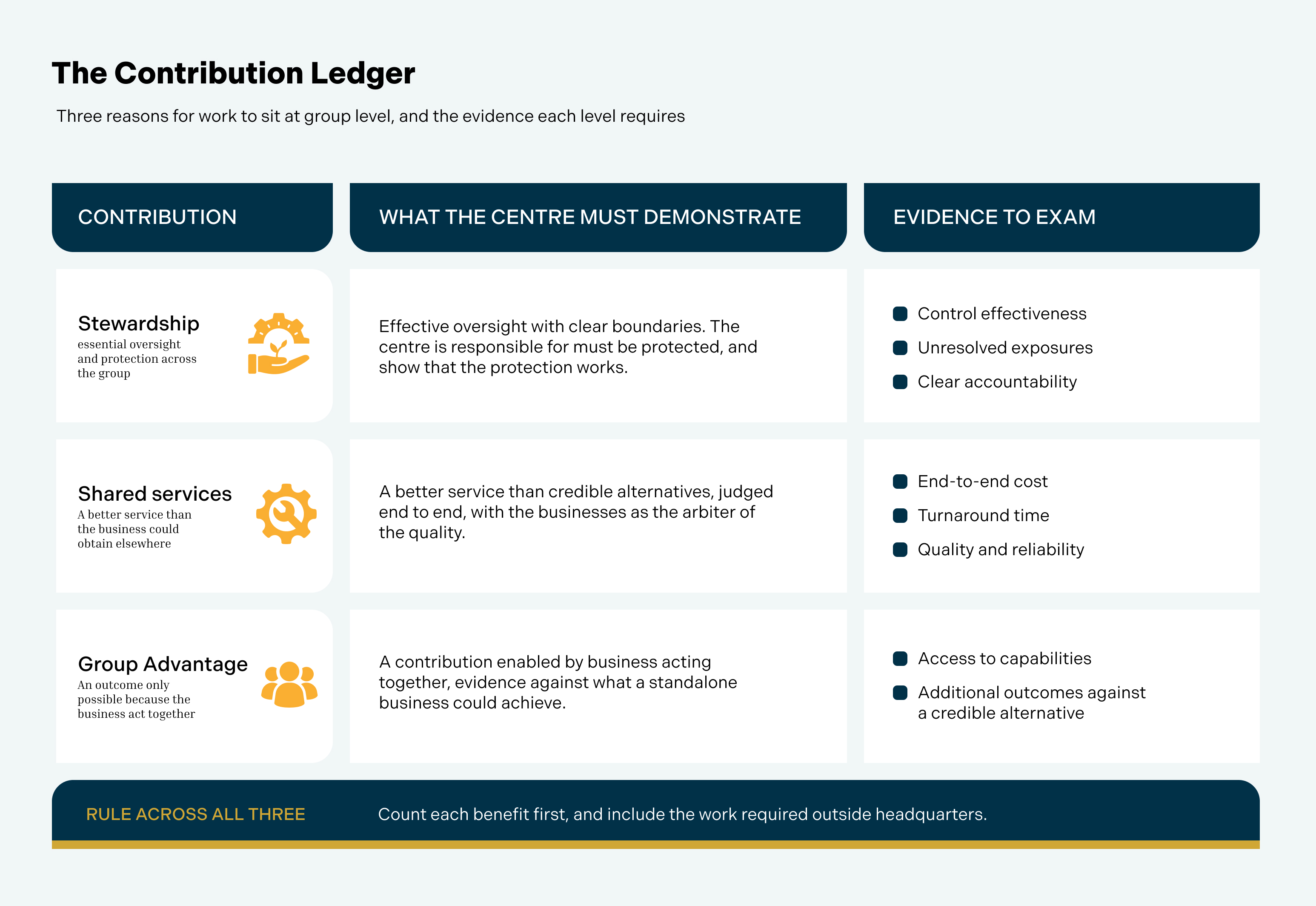
For state-owned groups, the stewardship distinction draws on the OECD’s separation of ownership expectations from operational autonomy.
A mandatory responsibility still deserves scrutiny of how it is delivered. Retaining an essential control should not exempt duplicate reporting or unnecessary approvals from examination. Nor should stewardship be forced into an artificial financial return.
Three claims, three burdens of proof
The question a board actually faces is not whether the center contributes. It is which contribution requires ownership at group level, which needs only coordination, and which could be obtained more cheaply elsewhere. Three claims, with three different standards of proof.
- A mandatory responsibility exists because law, regulation or fiduciary duty requires it. The claim is not in question; the delivery is. A mandatory obligation does not exempt duplicate reporting or unnecessary approval layers from examination, and it should not be forced into an artificial financial return.
- scale or service claim says the center does something better or more cheaply than the alternatives. This is the most testable of the three and the least often tested, because the comparison needs a credible alternative: a shared-service center, a lead business, an external provider. Without one, the claim is an assertion.
- A parenting claim says the group produces an outcome no standalone business could achieve. This is the hardest and the most valuable. It requires naming the opportunity, each business’s contribution, who convenes it, and the additional revenue, reduced risk or delivery improvement it produced, weighed against the cost of collaborating.
A portfolio of unrelated businesses may legitimately have no parenting claim at all, and be better served by disciplined capital allocation and operational independence. Collaboration has to earn its place too.
The reason for central ownership should be re-proved
Most decisions to centralize were sound when taken. The problem is that they are almost never revisited, and the conditions that justified them expire.
A capability was centralized because no business had the expertise. Three years later, two do. A control was retained at the center because the systems could not support local visibility. The systems now can. A service was consolidated for scale that the group has since sold.
So a center’s claim should carry a review date in the same way a capital decision does. The question at review is not whether the center is performing well, which it may be. It is whether the reason for central ownership still holds. A group that can answer that for each central activity has a different relationship with its own structure than one that inherits it.
Run the first review
- Agree the contribution. Define what should improve, for whom, and which obligations must remain protected. “Provide support” is insufficient; specify the service or outcome.
- Establish the full baseline. Record current performance, center expenditure and the effort required within the businesses. Include duplicate work and delays before claiming an efficiency gain.
- Test another arrangement. Compare central delivery with a shared service, a lead business or an external provider. Examine quality, control and continuity alongside cost.
- Make the decision reviewable. Agree what to retain, strengthen, relocate or simplify. Name the accountable leader, the evidence required and a review date.
The review may justify more investment at the center. It may reveal that a business already holds the expertise the group needs. The outcome should follow the evidence, including what the businesses can credibly deliver independently.
A group CFO should be able to explain the protection, service and advantage the management charge supports.
Every business can read its management charge. A center earns its place when it can show what that charge bought.
Questions for leadership
- Where are headquarters savings creating additional work within the businesses?
- Which shared capability gives our businesses an advantage they can demonstrate?
- What should the center remain accountable for while allowing the businesses greater operational authority?
.jpg)
.jpg)
.jpg)


