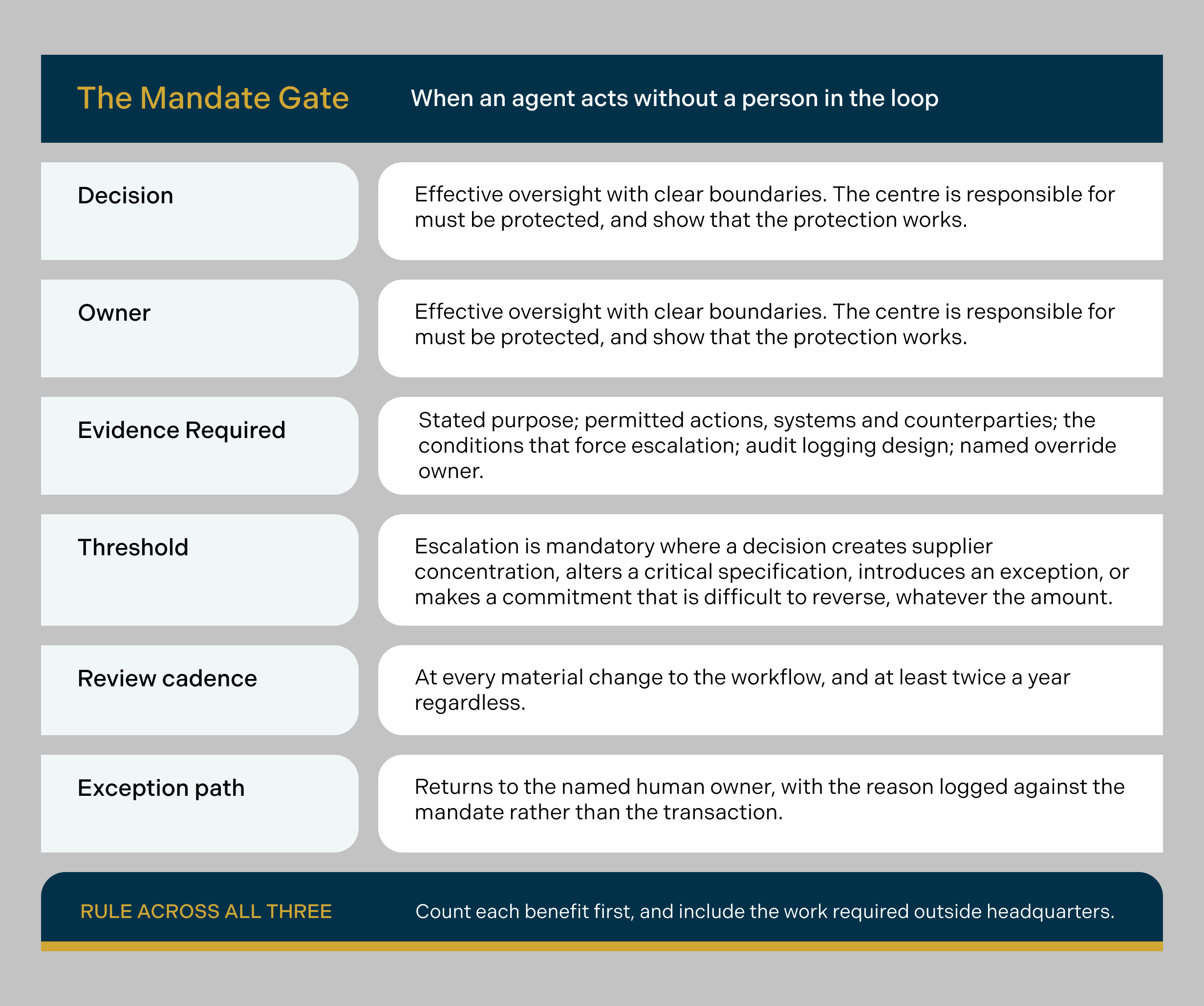
- Monetary authority is the wrong primary unit of delegation for an AI agent.
- Consequence should determine where human judgment returns.
- An agent whose mandate cannot be written down clearly is not ready to act on the organization’s behalf.

A Chief Procurement Officer authorizes an AI agent to search approved suppliers, compare quotations and place an order below a defined financial threshold. The agent selects the cheapest compliant offer. The supplier is approved and the purchase is within budget. But the decision extends the lead time on a critical item. It increases dependence on a supplier already carrying a significant share of spend, and it works against a volume commitment negotiated elsewhere in the business.
Nothing failed technically. The agent stayed within the authority it had been given. The weakness was in the authority itself: the threshold described the size of the transaction without capturing the consequences of the decision.
Permission was never the same as mandate
.svg)


A delegation matrix built for people carries one boundary, expressed in money. Financial value acted as a convenient proxy for materiality, because experienced people filled the gaps around it. An agent separates the three things that proxy was bundling.
Most frameworks have the first, imply the second and omit the third. An agent executes against whichever ones are written down.
There is a reason this arrives as an AI problem when it is not one. Automating a workflow whose delegation logic is already weak does not create the governance problem. It amplifies one the organization already had, and it removes what was compensating for it.
Where a matrix is incomplete, experienced people fill the gap with undocumented judgment, informal escalation and a quiet call to a colleague before committing. None of that is in the matrix. All of it was doing real work.
This is becoming an immediate management issue as AI systems move from generating recommendations toward taking actions across enterprise systems.
Saudi Arabia’s National AI Risk Management Framework provides one indication of that shift. The Saudi Data and AI Authority’s framework, version 1.0 dated April 2026, sets out a national methodology for AI risk. It covers identification, assessment, treatment and continuous monitoring across government and private-sector entities. It was introduced as an advisory reference rather than a new regulatory obligation.
The OECD’s updated AI Principles similarly emphasize human oversight, traceability and ongoing risk management appropriate to the context in which an AI system operates. [2]
For a CPO reviewing a delegation-of-authority matrix, the practical implication is clear. Monetary value can no longer carry as much of the delegation logic as it once did.
A SAR 20,000 purchase can materially affect an operation if it changes an engineering specification, introduces a new counterparty, exposes sensitive data or interrupts a critical service. A series of individually small purchases can also build a supplier concentration that no single transaction reveals.
Financial thresholds still matter. They simply do not describe the whole decision.
A useful mandate answers four questions: what is the agent for, what may it do, when must it stop, and who ultimately answers for the outcome.
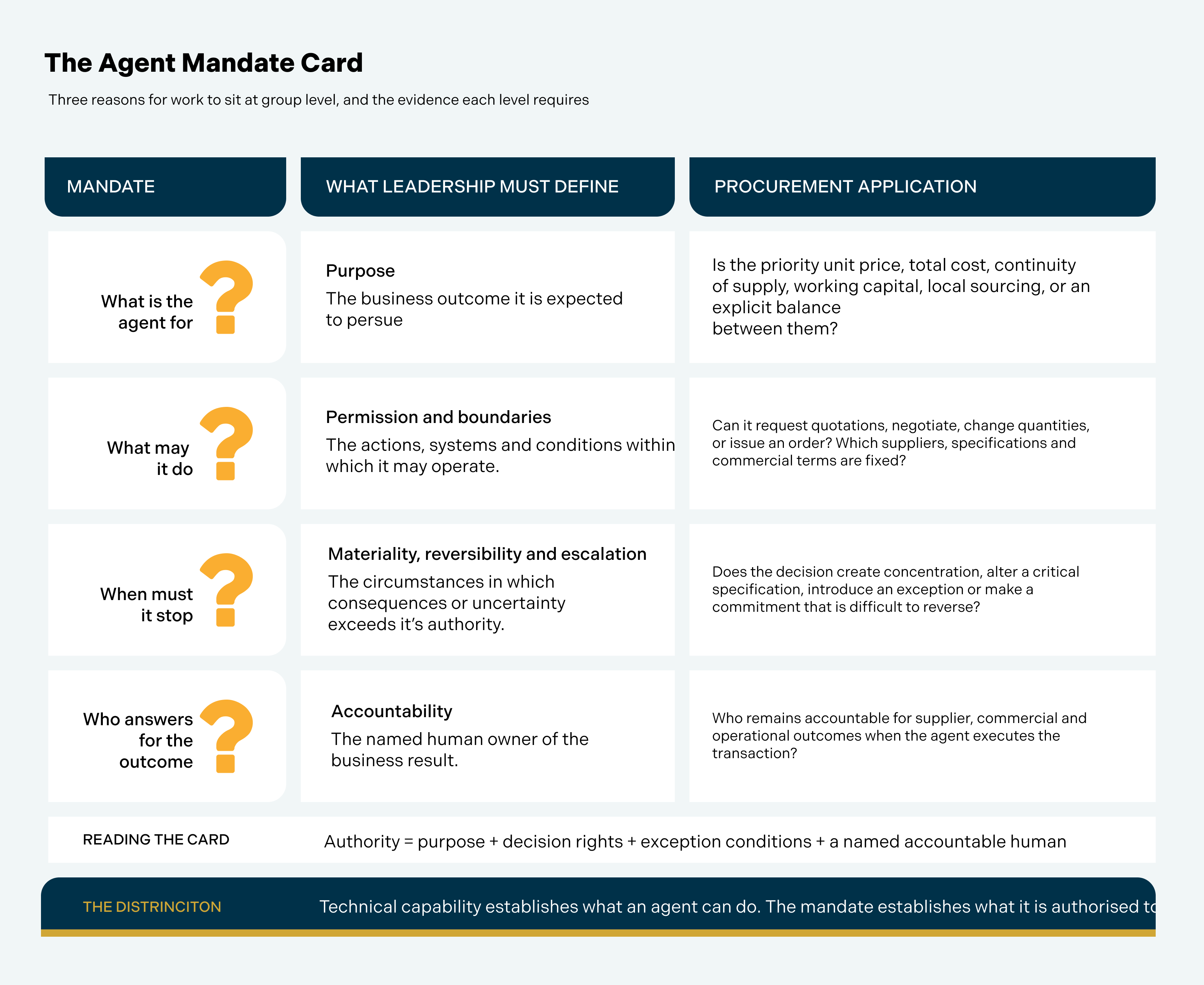
The distinction is the important one: technical capability establishes what an agent can do; the mandate establishes what the organization has authorized it to achieve.
Take a lower-value purchase that substitutes a component in operational equipment and introduces a supplier the business has not previously used. Its purpose may be to maintain continuity at acceptable total cost. The agent may be permitted to select among approved components but prohibited from changing a safety-critical specification. A new supplier or an irreversible specification change triggers escalation. The accountable procurement or engineering executive remains answerable for the resulting operational decision.
The value of the Mandate Card is not that it produces another checklist. It exposes where an organization has delegated an action without first defining the business judgment embedded inside it.
Many AI deployments naturally begin with recommendations, move through human approval and then allow greater autonomous execution as confidence grows.
Elapsed experience is the wrong trigger for the next level of autonomy. The better test is whether the organization understands the decisions embedded in the workflow well enough to delegate them.
Set the component substitution above beside a recurring order for a standard consumable from an approved catalog, within forecast demand and established commercial terms. The consumable order could support substantial autonomous execution. The substitution carries the greater consequence even though its financial value is lower.
This avoids both extremes. Organizations do not need a person approving every routine transaction merely because an AI agent executed it. Nor should an agent inherit authority simply because a purchase sits beneath a familiar financial threshold.
NIST’s AI Agent Standards Initiative makes the underlying change visible. Announced on 17 February 2026, the initiative focuses specifically on agents capable of autonomous action and on their secure interaction with external systems and organizational data.
As agents become technically able to do more, organizations need a more deliberate answer to what they should be allowed to decide.
Making consequence the governing test raises a question the test does not answer. Someone has to decide what counts as consequential, and that judgment is itself a delegation.
Set it too loosely and the mandate does nothing; the agent acts on everything and the threshold is decorative. Set it too tightly and the autonomy creates no value, because every execution returns to a person and the organization has bought an expensive approval queue.
More autonomy is not better past a certain point. Beyond it, the cost of controlling the agent exceeds the value of delegating the task.
There is also an accountability point worth stating plainly. When the agent acts as designed and within its mandate and the outcome is still poor, leadership has to examine the mandate rather than treat accountability as a machine problem. The executive who approved it owns that, which is why naming the accountable owner is not a formality.
Scope. Delegation limits, audit requirements and accountability for automated transactions are set by the law and regulation of the jurisdiction in which the entity operates. Confirm the mandate against local company, procurement and data law before an agent transacts.
There is no need to redesign the entire delegation framework at once. Begin with one workflow where autonomous action could create meaningful value.
Write the mandate and name the owner. Complete the Agent Mandate Card, connect it to the existing delegation framework and identify the executive who remains accountable for the outcome.
Different decisions within the same process will reach different levels of autonomy. That is a feature of good delegation, not a design failure. AI agents do not remove delegation. They make weaknesses in existing delegation harder to ignore.
Before giving an agent more autonomy, write down the mandate it is meant to serve. If that mandate cannot be stated clearly, the agent is not yet ready to act on the organization’s behalf.