The commercial team reports strong bookings. Finance reports lower recognized revenue. Treasury points to slower cash collections. The numbers can all be correct and still lead a board to three very different conclusions. Bookings and cash collections are not revenue. They are three commercial-cycle measures that a board may casually call revenue numbers, even though each answers a different question.
Key takeaways
A single source of truth should mean common definitions and traceable data, not one preferred number for every decision.
Bookings, recognized revenue and cash collections describe different points in the commercial cycle and should not be treated as substitutes.
The useful management question is not which number is right, but which number informs the decision in front of the board.
A board sees bookings rising and asks whether the business is growing. Finance points to slower revenue conversion, while Treasury raises concerns about collections. The instinct is to reconcile the three numbers until they tell the same story, but that is where good data can begin to produce poor management information.
A single source of truth was never a single number. It is a single set of definitions.
Share
Project businesses make the gap visible
The distinction matters most in project-led businesses, where commercial success, contractual performance, invoicing and cash receipt can occur months apart. In infrastructure, construction, engineering and project services, a contract can enter backlog today and generate accounting revenue over time. It is invoiced against milestones later, and converts to cash only after certification, payment terms, retention or dispute resolution. That sequence is where the board needs clarity.
Under IFRS 15, revenue recognition follows the satisfaction of contractual performance obligations. The standard also requires companies to disclose opening and closing balances of receivables, contract assets and contract liabilities, and to explain how the timing of performance relates to the timing of payment.
That relationship between performance and payment is often more useful to management than another isolated revenue number.
Follow the value through the business
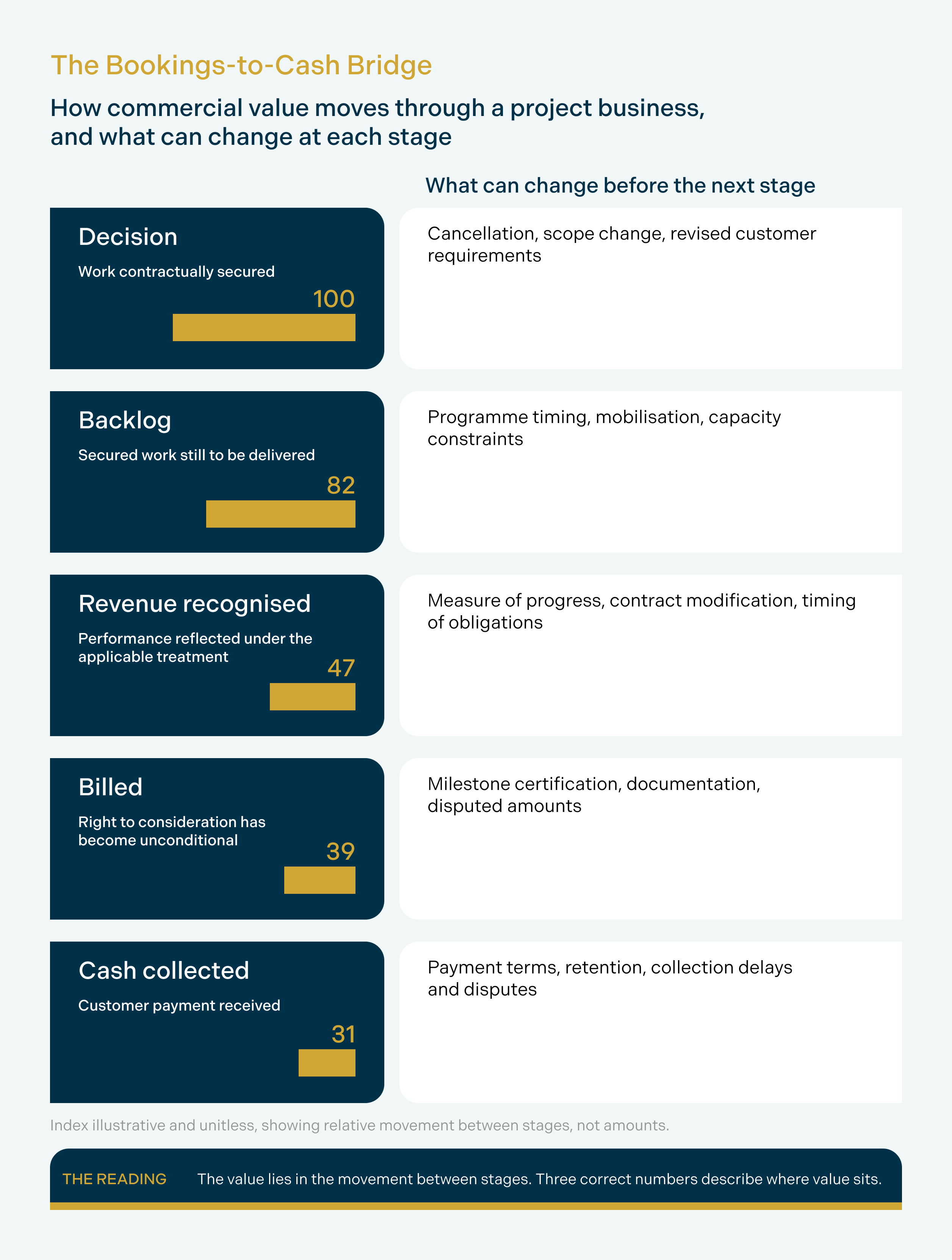
A project business should be able to explain how commercial value moves from one stage to the next.
The value of the bridge lies in the movement between stages and in what that movement reveals about the business.
If bookings rise but backlog is aging, the issue may be delivery capacity rather than demand.
If recognized revenue rises while receivables and contract assets expand faster, the board needs to understand the timing and quality of conversion.
If invoicing is healthy but collections slow, the decision moves again, toward working capital, customer exposure and liquidity.
The numbers have stopped conflicting. They are describing where value sits.
Match the metric to the decision
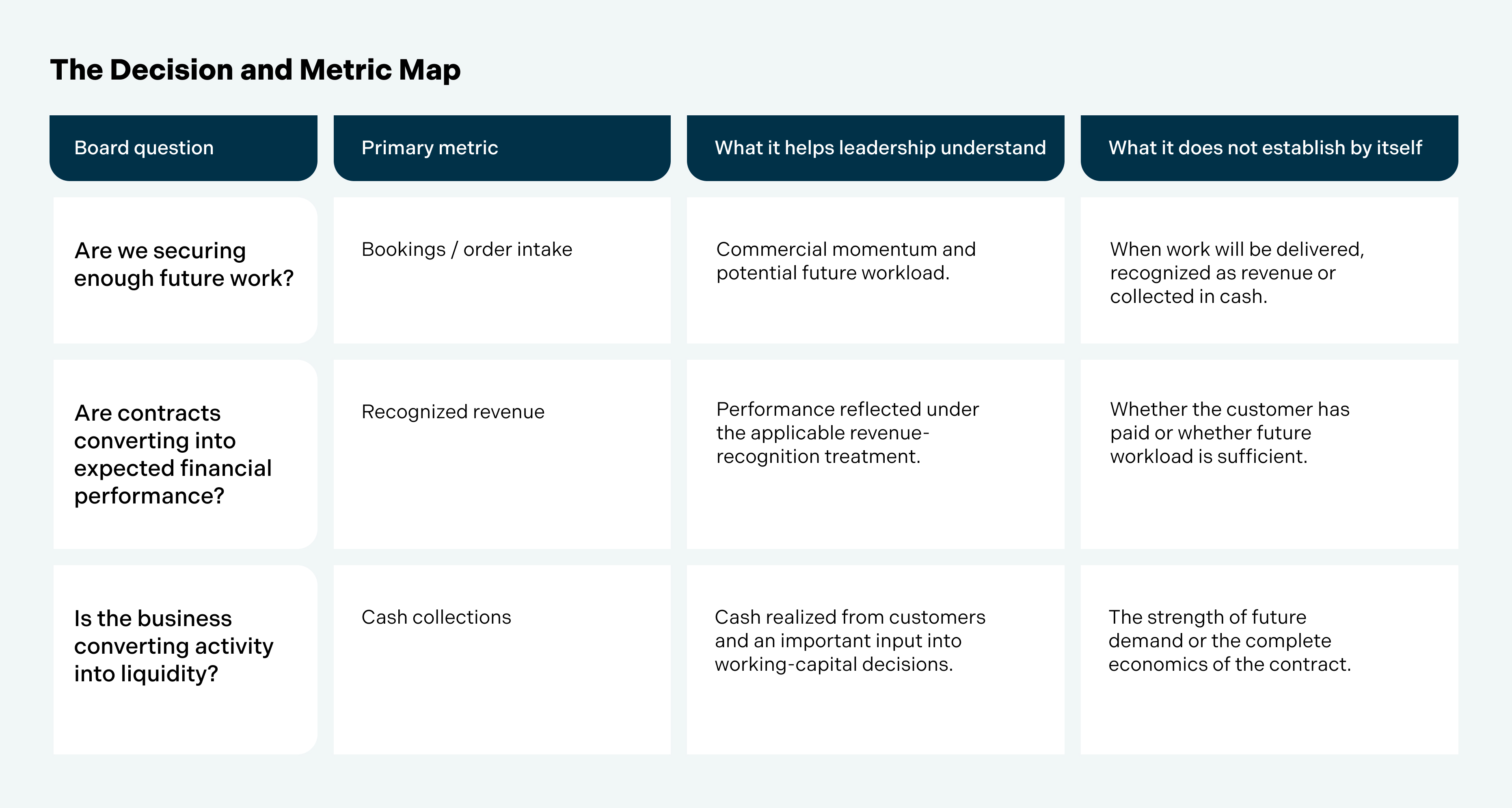
The Decision and Metric Map
The fourth column matters most because every metric has a boundary.
A common dashboard failure is to treat a good measure as though it answers a broader question than it was designed to answer. Strong bookings become evidence of financial performance. Revenue becomes a proxy for cash generation. Collections are interpreted without considering the work still being delivered.
A number becomes management information through five steps
Matching a metric to a question is the first half. A number reaching a board still has to pass four more steps before it can support a decision.
The trend says what direction it has moved. The variance says how far that is from what was expected. The cause says why, which is where most board packs stop and most decisions stall. The implication says what follows if it continues. The decision required says what leadership is being asked to do about it.
A pack that delivers trend and variance is reporting. A pack that reaches implication and decision is management information. The difference is not the quality of the data. It is how far the analysis was carried before it was circulated.
There is a second dimension that only shows up when a decision is urgent. Different decisions tolerate different ages of information. A liquidity decision may need cash data that is days old rather than weeks. A capacity decision can work from a secured workload position measured monthly. A strategic pipeline discussion may be well served by quarterly data and poorly served by weekly data that invites reaction to noise.
So the question to ask of any measure is not only which decision it informs, but how current it has to be for that decision to be safe. A correct number that is six weeks old is the right metric at the wrong cadence, and it fails quietly.
Build the board pack backwards
Many reporting processes begin with available data, organize it by function and send the resulting dashboard upwards. A stronger process begins with the decisions already approaching the board.
If leadership is deciding whether to add delivery capacity, it needs secured workload, timing and resource demand.
If it is testing current financial performance, it needs revenue alongside movements in contract assets, liabilities and receivables. IFRS 15 requires disclosure of these balances and explanations of significant changes between periods.
If the decision concerns liquidity, collections need to sit beside payment timing, receivables and upcoming cash commitments.
That is why “single source of truth” needs careful interpretation. The ambition should be one governed set of definitions and traceable data from which the enterprise can produce several valid decision views.
For a CFO, that changes the conversation when two numbers appear to disagree. Before asking which one is correct, ask whether they were ever supposed to describe the same thing.
A board does not need more numbers that agree with each other. It needs the right number for the decision in front of it.
Questions for leadership
Which measures in our board pack are being used to answer questions they were never designed to answer?
When bookings, revenue, billing and cash move differently, can management explain the bridge between them?
Does every major decision in the next board cycle have a clearly identified measure that informs it?
Share
References
IFRS Foundation. IFRS 15 Revenue from Contracts with Customers, particularly paragraphs 116 to 118. IFRS 15 requires disclosure of opening and closing balances of receivables, contract assets and contract liabilities. It also requires an explanation of how the timing of performance relates to the timing of payment, and of significant changes in contract balances. Issued Standards 2024, Part A. ifrs.org



.svg)